The top 20 fine wine performers of H1 2026 reveal a market returning to fundamentals
- Back-vintage Bordeaux dominated H1 2026, with mature vintages from 2013, 2015, 2016 and 2017 outperforming newer releases as investors prioritised proven quality and value.
- Sauternes was one of the standout categories of the first half, with three sweet wines ranking among the top six performers.
- The market rewarded fundamentals over speculation, with iconic producers across Bordeaux, Burgundy, Tuscany, the Rhone, Napa Valley and Chile delivering the strongest returns of H1 2026.
The best-performing fine wines of the first half of 2026 tell a story that extends far beyond individual price movements. While headlines during the first six months of the year focused on macroeconomic uncertainty, the Bordeaux 2025 En Primeur campaign and shifting global trade conditions, the secondary market rewarded a consistent set of characteristics: proven vintages, established producers, attractive pricing and scarcity.
The top 20 performing wines of H1 span Bordeaux, Burgundy, the Rhone, Tuscany, Napa Valley and Chile, demonstrating that opportunities have emerged across the broader market – diversity acting as a reassuring sign of recovery.
Several of these wines also delivered returns that comfortably exceeded those of many mainstream investments during the same period. While broad equity indices posted solid single-digit gains in H1 2026, seven wines in the top 20 appreciated by more than 25%. The comparison highlights an important distinction: although the fine wine market as a whole remained relatively subdued, careful wine selection generated exceptional returns.
Bordeaux leads H1’s top performers with back vintages
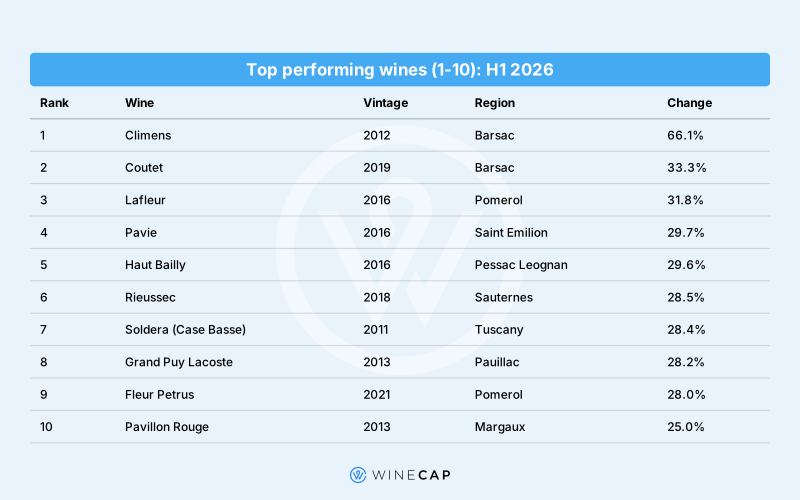
Bordeaux accounted for nine of the top 20 performers, making it comfortably the strongest represented region. More revealing, however, is which Bordeaux wines appeared in the rankings.
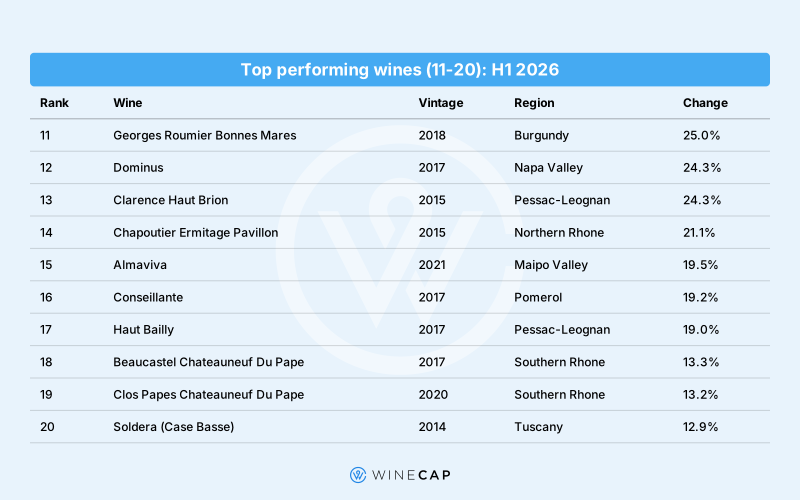
The list is dominated by back vintages rather than recent releases. Lafleur 2016 gained 31.8% during H1, Pavie 2016 rose 29.7%, Haut-Bailly 2016 climbed 29.6%, while Grand-Puy-Lacoste 2013 and Pavillon Rouge 2013 each posted gains of 25% or above. Elsewhere, Clarence Haut-Brion 2015, La Conseillante 2017 and Haut-Bailly 2017 also ranked among the year’s strongest performers.
This is the same trend that became increasingly apparent throughout the Bordeaux 2025 En Primeur campaign. Although the vintage received widespread critical acclaim and was released at historically attractive prices, buyers repeatedly compared new releases with outstanding back vintages already available on the secondary market. Where price differences were insufficient, investors often chose the mature alternative.
Recent Liv-ex data suggests this preference has continued beyond En Primeur. In June, almost every Bordeaux 2016 included in the Fine Wine 100 index rose in value, making 2016 the strongest-performing Bordeaux vintage year-to-date.
Sauternes quietly became one of the year’s standout performers
Perhaps the biggest surprise in the rankings is the dominance of sweet Bordeaux.
Chateau Climens 2012 topped the entire list after rising an exceptional 66.1% during the first half of the year, while Chateau Coutet 2019 followed in second place with a gain of 33.3%. Chateau Rieussec 2018 also appeared in sixth place with a 28.5% increase in value.
Although Sauternes represents only a small segment of the secondary market, its presence at the very top of the rankings reflects a broader improvement in demand for wines that have long traded below their intrinsic quality. Many leading Sauternes estates remain available at prices that compare favourably with similarly-rated dry wines from Bordeaux or Burgundy, while production volumes and long ageing potential continue to underpin scarcity.
The Liv-ex Sauternes 50 is the best-performing index so far this year, up 2.3%.
Diversification returns across the market
Although Bordeaux dominated numerically, the rankings demonstrated that the list of best performers has broadened considerably compared with recent years during the market’s most prolonged downturn.
Georges Roumier Bonnes Mares 2018 led the Burgundy rankings 25.0%, while Tuscany featured with Soldera Case Basse twice, with the 2011 vintage gaining 28.4% and the 2014 vintage adding 12.9%.
The Rhone contributed three wines: Chapoutier Ermitage Le Pavillon 2015 (+21.1%), Beaucastel Châteauneuf-du-Pape 2017 (+13.3%) and Clos des Papes Chateauneuf-du-Pape 2020 (+13.2%).
Meanwhile, the New World also made a strong showing through Dominus 2017 (+24.3%) and Chile’s Almaviva 2021 (+19.5%).
The diversity of the rankings suggests that recovery is broad-based and the market is increasingly selective rather than simply favouring one region over another. Buyers are allocating capital across multiple geographies, provided individual wines offer compelling combinations of quality, scarcity and relative value.
Producer strength continues to matter
Another recurring feature is the appearance of multiple vintages from the same estates.
Both Haut-Bailly and Soldera appeared twice in the top 20 list. Rather than rotating rapidly between fashionable names, the market appears to be concentrating on producers with consistent international demand and proven secondary market liquidity.
A market rewarding discipline
Taken together, the H1 rankings paint a picture of a market that has become increasingly rational following the correction of the past three years.
The top-performing wines are not speculative releases or newly discovered producers. Instead, they are established labels whose prices have reached attractive entry points relative to their long-term quality and reputation.
During market recoveries, demand first concentrates on wines where value is most apparent. During the first half of 2026, those opportunities were found in mature Bordeaux, overlooked Sauternes, iconic producers from Tuscany and the Rhone, and a select group of blue-chip New World estates.
If the first six months of the year demonstrated anything, it is that investors are once again rewarding fundamentals. Proven quality, scarcity, liquidity and sensible pricing have emerged as the defining characteristics of the market’s strongest performers. For long-term investors, that may prove to be the most encouraging signal of all.
FAQ: Top-performing wines in 2026 so far
Are fine wine prices recovering?
The first half of 2026 showed encouraging signs of improving market sentiment. While gains have been selective rather than broad-based, investors increasingly favoured mature vintages, established producers and wines offering strong relative value, resulting in significant price appreciation for a number of blue-chip labels.
How did Sauternes perform as an investment?
Sauternes combined relative value with increasing investor demand during the first half of 2026. Chateau Climens 2012 was the year’s best-performing wine, while Chateau Coutet 2019 and Chateau Rieussec 2018 also ranked among the top performers, highlighting renewed interest in sweet Bordeaux.
What does the H1 2026 ranking suggest about the fine wine market?
The rankings indicate that investors are prioritising established producers, mature vintages and relative value over speculative buying. Rather than chasing new releases, buyers have focused on wines with proven quality, strong liquidity and attractive entry prices.
Which producers appeared more than once among the top performers?
Several leading estates featured multiple times, including Chateau Haut-Bailly and Soldera (Case Basse). Their repeated appearances suggest that investors continue to favour producers with long-term reputations, consistent quality and strong secondary-market demand.
WineCap’s independent market analysis helps investors build diversified fine wine portfolios with full ownership and transparent pricing. Speak to one of our wine investment experts and start building your portfolio. Schedule your free consultation today.