Stronger US dollar puts fine wine’s currency independence in focus
- WineCap’s 2026 Wealth Report found 98% of surveyed US wealth managers see fine wine’s independence from the US dollar as important.
- The dollar is strengthening again, driven by geopolitical risk, resilient US data and expectations that rates will stay higher for longer.
- A stronger dollar can lower the acquisition cost for US buyers of euro- and sterling-priced wine, but fine wine’s long-term value still rests on scarcity, provenance and collector demand.
The US dollar has regained momentum amid renewed geopolitical uncertainty, resilient US economic data and expectations that American interest rates could remain elevated for longer.
The Dollar Index, which measures the currency against a basket of major peers, has moved back above 101. Performance has fluctuated day to day, but the dollar has strengthened by around 1% over the past month and just over 3% over the past year. Safe-haven demand linked to tensions in the Middle East has provided further support, alongside relatively high US bond yields and a more cautious outlook for Federal Reserve policy.
A stronger dollar has consequences far beyond foreign exchange markets. It can make imports cheaper for US consumers while making American exports less competitive, potentially placing upward pressure on the US trade deficit. It can also raise the burden of dollar-denominated debt in emerging markets and increase the local cost of commodities and other imports for countries whose currencies are weakening.
For fine wine investors, however, the implications are more nuanced.
Fine wine is not globally priced in dollars the way oil and many other commodities are. Its value is shaped principally by scarcity, producer reputation, vintage quality, provenance and demand from collectors around the world. Currency movements affect what investors pay in their domestic currency, but they don’t automatically determine whether the underlying price of a wine rises or falls.
Our survey for the 2026 US Wealth Report found that wealth managers increasingly see this distinction as a core part of fine wine’s investment appeal.
Conviction about fine wine’s currency independence is growing
WineCap’s 2026 Wealth Report asked wealth managers how important it was that fine wine is not pegged to the US dollar.
In total, 98% described this characteristic as either important or very important – maintaining the exceptionally high level recorded in 2025 and rising from 92% in 2024.
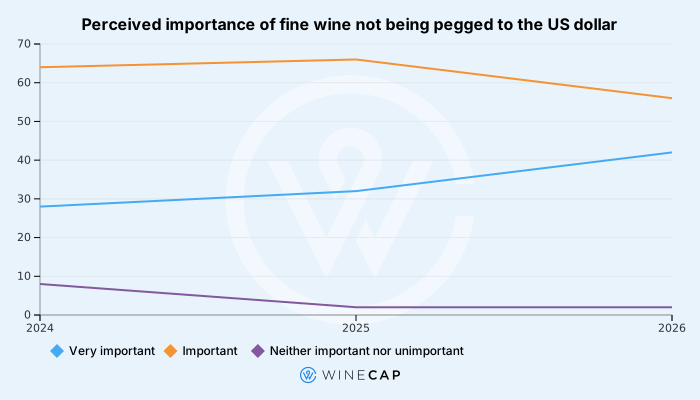
The more notable development is the growing strength of conviction. The share of respondents who considered fine wine’s independence from the dollar “very important” rose from 28% in 2024 to 32% in 2025 and 42% in 2026 – a 50% increase over two years. Only 2% were neutral on the issue in 2026, and none considered it unimportant.
The findings arrive as currency risk becomes a more visible consideration for global investors. Inflation, divergent central bank policies, geopolitical instability and shifting capital flows have driven significant swings across major currencies.
Against that backdrop, assets whose fundamental value isn’t tied to the monetary policy or exchange rate of a single country may become increasingly attractive as portfolio diversifiers.
Why a stronger dollar matters globally
The dollar occupies a unique position in the international financial system – widely used in cross-border trade, commodity pricing, foreign exchange reserves and international borrowing. Changes in its value, therefore, have an outsized effect on the global economy.
When the dollar rises, goods imported into the US become cheaper in dollar terms, helping to ease some imported inflation; American consumers and businesses can buy more from overseas for the same money. The opposite holds elsewhere: a weakening domestic currency makes dollar-priced imports more expensive, potentially adding to inflation in economies that depend heavily on imported energy, food or industrial materials.
Emerging markets are particularly exposed. Governments and companies there often borrow in dollars while earning revenue in local currencies, so when the dollar appreciates, the domestic-currency cost of servicing that debt rises. The IMF has found that emerging economies are especially vulnerable given the dollar’s dominant role in both trade invoicing and cross-border debt – roughly 40% of world exports and around half of international debt securities are dollar-denominated, exposing these economies to exchange-rate volatility largely beyond their control.
Commodities can also face downward price pressure when the dollar strengthens, since many are quoted in dollars and become costlier for buyers using other currencies. That said, supply shocks, geopolitics and the economic cycle can outweigh the currency effect – oil’s recent gains amid Middle East tensions, despite a firmer dollar, illustrate why the relationship isn’t mechanical.
The effect on trade is similarly directional. A stronger currency tends to make imports cheaper and exports more expensive, which can widen the US trade deficit – though the actual outcome also depends on domestic demand, global growth, tariffs and how quickly businesses and consumers adjust to exchange-rate changes.
Fine wine follows different fundamentals
Fine wine differs from conventional commodities in several important respects. It isn’t a standardised, interchangeable product – each wine is tied to a particular producer, region and vintage, and available supply shrinks as bottles are consumed. Two wines from the same appellation can perform very differently depending on critical reception, production volumes, age, provenance and collector demand.
The market is also geographically diverse. Many of the most important investment-grade wines are produced in France and Italy, while London remains a key centre for international secondary market trading. Wines may therefore be priced in sterling or euros even when the end buyer is based in the US, Asia or the Middle East.
None of this makes fine wine immune to currency movements – exchange rates can affect demand, merchant margins, international trade and the timing of purchases. However, it does mean a stronger dollar doesn’t automatically push the underlying price of a case of Bordeaux, Burgundy or Champagne in either direction. The wine’s value continues to reflect conditions within its own market.
Does today’s dollar strength create a buying opportunity?
For US investors, a stronger dollar can improve purchasing power when acquiring fine wine priced in sterling or euros. When the dollar rises against the euro, an American buyer needs fewer dollars to purchase the same wine, provided its local market price hasn’t changed. This essentially means a more attractive entry point without requiring the underlying wine price to fall.
The current picture is mixed rather than uniform. The dollar has strengthened broadly over the past month and has recently benefited from safe-haven demand, making clearer gains against the euro, which has been pressured by geopolitical and energy concerns. Sterling has shown greater resilience, recovering some ground against the dollar through early July.
American buyers may therefore have a more obvious currency advantage sourcing euro-denominated wines than sterling-priced stock right now. The opportunity also depends on the comparison window: the dollar may be stronger over one month but weaker against a particular currency over a shorter period.
Transaction costs, storage, tax, shipping and merchant pricing matter too – a favourable exchange rate alone doesn’t make an individual wine attractive. The more relevant point is that currency strength can give investors added flexibility. US collectors may use periods of dollar appreciation to acquire European stock more efficiently, particularly when underlying wine prices are stable or older vintages offer relative value.
Currency is an entry-point consideration
Fine wine’s independence from the dollar shouldn’t be confused with an expectation that it will rise whenever the dollar strengthens. A favourable exchange rate can lower a US investor’s acquisition cost, but subsequent returns still depend on the wine itself – scarcity, condition, producer demand, market liquidity and the price paid remain the more important long-term considerations.
The same principle applies in reverse: a US investor holding wine priced or traded in sterling may benefit from currency appreciation when converting value back into dollars, but foreign exchange movements can also work against them. Currency represents an additional layer of portfolio performance, not the underlying investment case.
Our Wealth Report findings suggest wealth managers increasingly understand that distinction. Almost all respondents already considered fine wine’s lack of a dollar peg important in 2025; the development in 2026 is the rise in those who regard it as very important. It seems that amid greater uncertainty around inflation, interest rates and international capital flows, wealth managers are placing more weight on assets whose value is supported by their own supply-and-demand dynamics.
A stronger dollar may currently allow some US investors to buy European fine wine more competitively. But the broader appeal lies in the fact that fine wine doesn’t depend on the dollar continuing to rise. Its long-term value remains rooted in something more specific: a finite supply of sought-after wines and sustained demand from a global collector base.
FAQ: Fine wine and US dollar
Is fine wine pegged to the US dollar?
No. Fine wine isn’t a globally dollar-priced commodity like oil. Its value is driven by scarcity, producer reputation, vintage quality, provenance and collector demand, not by a single currency.
How does a stronger US dollar affect fine wine prices?
A stronger dollar changes what a wine costs a buyer in their home currency and can affect merchant margins and purchase timing, but the wine’s own market – driven by scarcity and demand – still sets its value.
Why do wealth managers care about fine wine’s currency independence?
It offers portfolio diversification away from assets whose value is tied to US monetary policy or the dollar’s exchange rate. The share of wealth managers calling this “very important” rose from 28% in 2024 to 42% in 2026, a 50% increase, as currency volatility has become a bigger concern for global investors.
Is now a good time for US investors to buy European fine wine?
A stronger dollar can lower the acquisition cost of euro- and sterling-priced wine for US buyers. Currency is only an entry-point advantage, though – it doesn’t determine long-term returns.
What currency is fine wine priced in?
Fine wine is most commonly traded in sterling and euros, reflecting London’s role as a secondary-market trading hub and the concentration of top producers in France and Italy, even when the end buyer is based in the US, Asia or the Middle East.
Does currency risk affect fine wine investment returns?
Yes, but as an additional layer on top of the investment case, not the case itself. Exchange-rate moves affect what an investor pays or receives when converting value back to their home currency, while long-term returns depend on scarcity, condition, provenance and collector demand.
What is the WineCap Wealth Report?
It’s WineCap’s annual survey of wealth managers on fine wine as an asset class, tracking sentiment on topics including currency independence, demand outlook and portfolio allocation. The 2026 edition found 98% of respondents view fine wine’s independence from the dollar as important, up from 92% in 2024.
WineCap’s independent market analysis helps investors build diversified fine wine portfolios with full ownership and transparent pricing. Speak to one of our wine investment experts and start building your portfolio. Schedule your free consultation today.