The investor’s guide to Gaja: 10 things you need to know
- Gaja has consistently been recognised as one of the most powerful Italian producers.
- Gaja’s best-performing investment wines are Gaia & Rey, Sperss, and the multi-vineyard Barbaresco, which offer stronger returns at lower entry prices.
- Although Gaja remains best known for its Barbarescos, it now makes more wine in Tuscany than in Piedmont.
Gaja is arguably Italy’s most influential fine wine producer. Founded in Barbaresco in 1859, the family estate helped transform both the reputation of Italian wine and the global market for Nebbiolo. Yet for investors, Gaja offers an unexpected lesson: its most famous wines are not necessarily its best-performing assets. Here are ten things every wine investor and collector should know.
1. Gaja sits at the top of the Italian fine wine hierarchy
Gaja occupies a position in Italian wine that no other producer quite matches. The house is built on Barbaresco (the DOCG appellation in the Langhe hills of northwest Italy that produces Nebbiolo-based red wines), but its reach extends to Tuscany, where it operates two separate estates. Few Piedmontese producers have made that crossing; fewer still have done so with critical and commercial success.
For investors, that breadth matters. Piedmont and Tuscany carry different collector bases, different vintage cycles, and different secondary market dynamics. The decision to anchor the house in Barbaresco rather than Barolo (the other great Nebbiolo appellation, and the one that typically dominates international collector attention) is both historically determined and commercially distinctive.
2. Five generations of family ownership since 1859
Gaja was founded in 1859 by Giovanni Gaja in the village of Barbaresco and has remained in the same family for five generations without being sold, merged, or taken outside family control. That continuity is exceptional in European fine wine, where inheritance pressures and capital requirements have pushed many historic estates toward corporate ownership over the past half century.
The current generation is led by Angelo’s three children: Gaia, Giovanni, and Rossana Gaja. Gaia serves as the public face of the business and drives its commercial direction. The handover from Angelo, who transformed the estate into an internationally recognised brand from 1961 onwards, has been gradual and deliberate.
For investors, family ownership signals long-term strategic consistency: the priorities that have defined Gaja’s approach, quality above volume, estate-grown grapes over bought-in fruit, personal identity over corporate anonymity, are structurally embedded rather than dependent on any external shareholder agenda.
3. How Angelo Gaja changed Italian wine from a single cellar
Angelo Gaja took over the family winery in 1961 at the age of 21. What followed was one of the most consequential individual interventions in Italian wine history. Angelo had studied oenology in France and observed what was happening in Burgundy and Bordeaux: green harvesting (removing a proportion of grape bunches in summer to concentrate the remaining crop), higher vine density, aging in small French oak barriques rather than the large Slavonian oak casks (botti) that had defined Piedmont’s cellars for generations.
He introduced all of these practices in Barbaresco, where they were deeply unfamiliar. He also pioneered the bottling of single-vineyard Barbaresco, beginning with Sori San Lorenzo in 1967, at a time when almost all Barbaresco was blended across multiple vineyard sites. That decision reframed the appellation’s identity, establishing the concept of named individual crus that today defines how the finest Barbaresco and Barolo are understood by collectors.
4. Gaja spent 130 years making only Barbaresco
For the first 130 years of its history, Gaja made wine exclusively in Barbaresco. Although Barolo is often considered Piedmont’s flagship appellation, the estate remained committed to its home region and refused to expand until it could do so on its own terms.
That opportunity came in 1988, when Gaja acquired vineyards in Serralunga d’Alba, one of Barolo’s most prestigious communes. True to the family’s philosophy, the estate only entered the appellation after securing vineyards of its own, rather than buying fruit from growers. The result is a relatively small Barolo portfolio centred on Sperss, Conteisa and Dagromis, produced to the same standards as its Barbaresco wines.
The timing proved significant. As Barolo’s international reputation grew rapidly through the 1980s and 1990s, Gaja chose patience over speed, prioritising estate ownership and long-term quality over immediate commercial opportunity. That disciplined approach continues to define the producer today.
5. The 1996 declassification that shook Piedmont
In 1996, Angelo Gaja made a decision that the Piedmont wine establishment found deeply unsettling. He voluntarily declassified all of his single-vineyard Barbarescos, along with his Barolo Sperss, from their respective DOCG classifications (Italy’s highest appellation tier) to the far less prestigious Langhe Rosso DOC. The reason was practical: he wanted to blend approximately five percent Barbera (a widely grown Piedmont grape variety) into the wines, which the Barbaresco and Barolo regulations did not permit.
The decision provoked considerable debate. A producer at the very top of Italian wine choosing to label its flagships with a classification associated with everyday table wine sent a pointed message about how the house ranked its own winemaking priorities relative to appellation politics. Departing the classification attracted far more attention than the return to it: from 2013, Gaja began the gradual process of re-entering DOCG classification, a decision that passed with notably little controversy.
6. The Gaja range spans Piedmont and Tuscany
Today, Gaja produces more than 20 wines across Piedmont and Tuscany, making it one of Italy’s most diverse fine wine producers. While the estate is synonymous with Barbaresco, its portfolio now spans Nebbiolo, Chardonnay, Cabernet Sauvignon and Brunello di Montalcino, offering collectors a wide range of styles and investment opportunities.
The estate’s most iconic wines are its three single-vineyard Barbarescos: Sori San Lorenzo, first released in 1967 and renowned for its structure and longevity; Sorì Tildin, often regarded as the flagship of the trio; and Costa Russi, typically the most approachable in its youth. Alongside these sits Gaja Barbaresco, the multi-vineyard blend that the family considers its flagship wine and one that has historically offered excellent value for investors.
Following its expansion into Barolo, Gaja introduced three distinct expressions of the appellation. Sperss, sourced from Serralunga d’Alba, is the estate’s benchmark Barolo and one of its strongest long-term investment performers. Conteisa, produced from vineyards in La Morra and Serralunga, offers a more elegant style, while Dagromis provides an earlier-drinking introduction to the range.
Beyond Nebbiolo, Gaja has produced one of Italy’s most celebrated white wines since 1979. Gaia & Rey, named after Angelo Gaja’s daughter and grandmother, helped establish Chardonnay as a serious fine wine in Italy and remains one of the producer’s best-performing investment wines.
The family’s Tuscan estates complete the portfolio. Ca’Marcanda in Bolgheri produces Camarcanda, Magari and Promis, while Pieve Santa Restituta in Montalcino is dedicated to Brunello di Montalcino, including the highly regarded single-vineyard Sugarille. Today, Gaja produces more wine in Tuscany than in its historic Piedmont home – a fact that surprises many collectors.
7. A producer willing to name his wines with a sense of humour and a long memory
Angelo Gaja has shown a consistent willingness to mark his more unconventional decisions with names that acknowledge rather than obscure them. In 1982, he planted Cabernet Sauvignon in some of Barbaresco’s finest vineyard land. His father, Giovanni Gaja, responded with the Piedmontese exclamation “Darmagi!” (meaning “what a pity”). Angelo named the resulting wine Darmagi (“what a pity”), turning his father’s criticism into one of Italy’s most recognisable wine labels.
Ca’Marcanda, the larger of Gaja’s two Tuscan estates, carries an equally self-aware name. “Ca’Marcanda” translates from local dialect as “House of Haggling,” or “House of endless negotiation” a direct reference to the long and protracted negotiations that preceded Angelo’s acquisition of the Bolgheri property from the local farmers who had previously owned it.
Brand personality of this kind carries value: wines with a strong narrative identity attract collector attention and media coverage that sustains long-term demand.
8. A track record of choosing quality over revenue
Gaja has never been afraid to sacrifice short-term revenue to protect the long-term reputation of the estate. Following a challenging growing season in 2002, the family chose not to bottle any wine under the Gaja label, selling the entire vintage in bulk instead. For a producer of Gaja’s stature, it was an extraordinary decision.
The same philosophy guided the 2012 vintage. Rather than release its celebrated single-vineyard Barbarescos, Sorì San Lorenzo, Sori Tildin and Costa Russi, Gaja redirected the fruit into its multi-vineyard Barbaresco. The estate concluded that the wines did not meet the standard expected of the individual crus.
This disciplined approach has become one of Gaja’s defining characteristics. By withholding wines that fall short of its benchmark, the estate reinforces confidence in every bottle that reaches the market – a quality that helps underpin both its reputation and its long-term investment appeal.
9. One of the world’s strongest fine wine brands
Gaja’s reputation extends far beyond Italy. In the Liv-ex Power 100 – the annual ranking of the world’s most powerful fine wine brands based on price performance, trade activity and market value – Gaja reached second place in 2024, the highest ranking ever achieved by an Italian producer. Although it slipped to eleventh in 2025, it remained among the world’s most influential fine wine brands.
Its secondary market presence is equally impressive. By trading volume in 2025, Gaja ranked among Italy’s six most actively traded producers, alongside names such as Sassicaia, Ornellaia, Giacomo Conterno, Valdicava and Produttori del Barbaresco.
Few producers combine brand prestige with this level of market liquidity. Gaja’s wines are sought after by collectors worldwide, yet they also trade consistently on the secondary market, making the estate one of the cornerstones of Italian fine wine investment.
10. Gaja’s best investments aren’t its most famous wines
The most important lesson for investors is that Gaja’s flagship wines are not necessarily its strongest performers. While Sori San Lorenzo, Sori Tildin and Costa Russi command the greatest attention and the highest release prices, Wine Track data shows that Gaia & Rey, Sperss, Conteisa and the multi-vineyard Gaja Barbaresco have historically delivered stronger percentage returns.
The reason is simple. These wines benefit from the full strength of the Gaja brand while entering the market at more accessible prices, leaving greater scope for appreciation as demand grows. By contrast, the single-vineyard Barbarescos are priced to reflect their prestige from the outset.
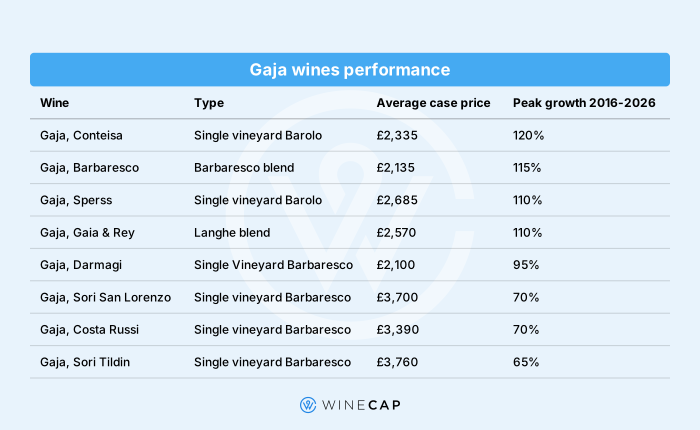
This pattern is not unique to Gaja. Across many of the world’s leading producers, the greatest investment opportunities often sit just below the flagship tier, where brand recognition remains exceptionally strong but release prices are less fully valued.
For investors building an Italian fine wine portfolio, Gaja offers more than a collection of iconic labels. It combines one of the industry’s strongest brands with deep secondary market liquidity and a range of wines that appeal to different budgets and investment objectives. Looking beyond the headline bottles can uncover some of the estate’s most compelling long-term opportunities.
FAQ: Gaja
How liquid are Gaja wines on the secondary market?
Gaja ranked among the six most heavily traded Italian fine wine brands by volume in 2025, behind only Giacomo Conterno, Valdicava, Ornellaia, Sassicaia, and Produttori del Barbaresco. The single-vineyard Barbarescos carry the strongest name recognition, but the multi-vineyard Barbaresco and Sperss Barolo also trade with consistent frequency.
What is the best entry point in the Gaja range for a new investor?
The multi-vineyard Gaja Barbaresco and the Sperss Barolo offer the most accessible entry from an investment perspective: both carry the full weight of the Gaja brand at lower price points than the single-vineyard crus. Gaia & Rey, the Langhe Chardonnay should not be overlooked.
How important is vintage selection when investing in Gaja?
Vintage selection matters significantly just as much in Piedmont as elsewhere and Nebbiolo’s sensitivity to growing conditions produces marked variation between years. Gaja’s own quality decisions reinforce this: the 2002 vintage was sold in bulk without bottling, and no single-vineyard wines were produced in 2012.
Does Gaja’s Tuscan presence strengthen or dilute its investment case?
The fact that Gaja now produces more wine in Tuscany than in Piedmont reflects genuine strategic commitment rather than opportunistic expansion, and strengthens rather than dilutes the overall brand.
WineCap’s independent market analysis helps investors build diversified fine wine portfolios with full ownership and transparent pricing. Speak to one of our wine investment experts and start building your portfolio. Schedule your free consultation today.