The impact of climate change on wine: what investors need to know
- The impact of climate change on wine is already measurable: French harvest dates have moved forward by an average of two to three weeks since the 1980s.
- 70% of today’s wine regions could face substantial suitability loss if warming exceeds 2°C, while only around a quarter stand to benefit.
- Fine wine investors may be unusual beneficiaries of climate disruption in the medium term, as heritage regions decline and demand concentrates on a shrinking supply of established vintages.
Climate change is reshaping the conditions that make great wine possible. The effects are already visible in the vineyard: harvest dates, the varieties planted, and the hierarchy of individual sites within long-established regions are all in motion. Research published in Nature in 2024 found that up to 70% of the world’s current wine regions could face substantial suitability loss if warming exceeds 2°C.
For fine wine investors, this is not background noise, nor is it a theory up for debate. The supply, style, and geography of the world’s most collected wines are changing now, and investors who understand these structural changes will be better equipped to assess long-term scarcity, quality and regional risk.
Climate change is already measurable
Viticulture traditionally happens on marginal farming land that’s unsuitable for other crops by virtue of its elevation, gradient or soil quality. Very often grapes are grown at the boundary of what a given climate can reliably ripen, making vineyards an effective early-warning system for changing conditions. Harvest dates across France’s major wine regions have moved forward by two to three weeks on average since the 1980s. Among producers and viticultural scientists, the direction of change is no longer seriously disputed.
The 2024 study in Nature Reviews Earth and Environment provides the most comprehensive quantification of what lies ahead. The 2°C threshold, the same target at the centre of international climate policy, marks the boundary between disruption that can be largely managed within existing winegrowing regions and disruption that reshapes the industry structurally.
A new global wine map: winners and losers
Climate change creates redistribution, not uniform loss. Some regions stand to benefit from warming; others face mounting pressure. The investment significance of this redistribution will take decades to register fully in secondary market pricing.
- English sparkling wine is one of the clearest and earliest quality beneficiaries. The warming of southern England has made consistent ripeness achievable, with producers including Wiston, Nyetimber and Gusbourne now drawing serious critical attention.
- Hot Mediterranean climates are already under significant stress. Rising temperatures compress the window for retaining the freshness and acidity that define quality in many of the region’s key varieties.
- California climate projections suggest suitable wine-growing area could shrink by up to 50% under current warming trajectories, with lower-elevation vineyards most exposed.
- Northern Atlantic regions (Brittany, parts of northern England, northern Germany) are potential beneficiaries as warming gradually extends suitable growing conditions northward.
The pace of change will not be even. Regions close to the 2°C tipping point face the most acute near-term risk while those in cooler margins may see quality improve before conditions deteriorate.
However, greater suitability for grape growing does not automatically translate into investment-grade wines. Reputation, critical recognition and secondary market liquidity take decades to establish.
Local hierarchies within regions are shifting too
The changes are not only between regions. Within established appellations, the relative quality ranking of individual vineyard sites is under revision for the first time in generations. The best plots of one era are not guaranteed to be the best plots of the next.
Three forces drive this internal redistribution. South-facing slopes, which maximise sun exposure and were long considered the premium position within most northern hemisphere appellations, are now less automatically desirable in regions where warming has already advanced: additional sun can produce heat stress rather than quality. Higher-altitude vineyards, which cool more quickly at night and retain acidity more effectively, are gaining relative standing. Sites with reliable access to water, through proximity to rivers, groundwater, or other sources, are becoming increasingly valuable as summer drought stress affects more of the growing season across more regions.
For investors, knowing the site matters more than it did a generation ago, and the sites worth knowing are changing.
Earlier harvests alter wine style
Harvest dates have advanced by weeks across many of the world’s leading wine regions, reflecting faster ripening under warmer conditions. For producers, this means managing grapes that accumulate sugar more quickly while trying to preserve acidity and freshness.
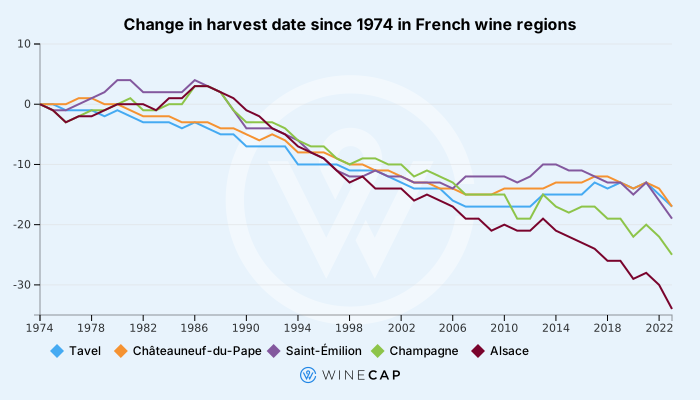
For investors, the implication is that the climatic conditions behind many of the most celebrated long-lived vintages are becoming less common. As growing seasons compress, producing wines with the same balance, complexity and ageing potential becomes increasingly challenging, even as producers adapt through changing viticultural practices.
Extreme events and shrinking yields
Shifting averages describe the trend. Extreme events determine the vintage. A warmer, more energetic atmosphere generates weather events of greater frequency and severity, and their effect on annual production can be immediate and severe. In Bordeaux, production data illustrates the pattern directly with a clear trend of falling harvests that cannot be explained by a reduction in vineyard area. 2024 and 2025 were the two smallest harvests in the region since 1991. The clustering of very small harvests in the recent period reflects a growing season increasingly shaped by extremes rather than reliable averages.
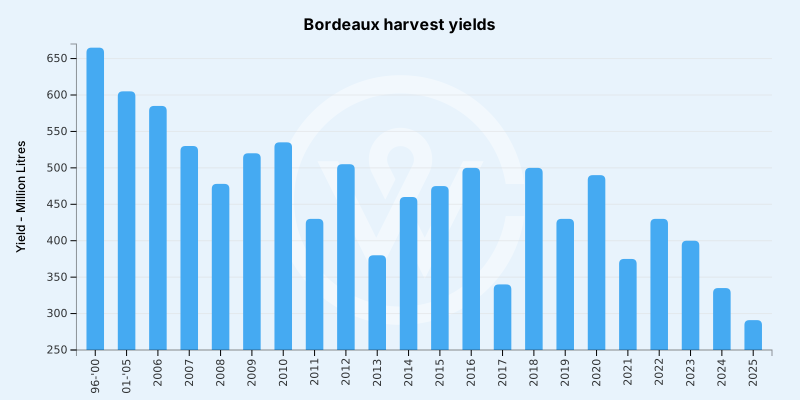
*Data from Gavin Quinney and CIVB.
Three types of event drive the most acute production losses in fine wine regions:
Frost
A warming climate triggers earlier budburst, exposing young shoots to late-season frost events that previously arrived before the vine had emerged from dormancy. The April 2017 frosts across Burgundy, Champagne, and Chablis destroyed the majority of that year’s crop in affected appellations.
Hail
Warmer temperatures increase the energy available to storm systems, raising the frequency and intensity of localised hailstorms. A single event can destroy an entire year’s production in a specific vineyard.
Drought
Water stress causes its own issues, but high temperatures and dry vegetation have also expanded fire risk across California, southern France, and Australia, threatening both vineyards and the surrounding infrastructure.
Water stress and the rules that may have to change
Water stress is one of the most significant long-term challenges facing fine wine production in warmer climates. Many of the world’s most prestigious appellation systems have historically prohibited or severely restricted irrigation, based on the belief that moderate water stress encourages deeper root systems and concentrates flavour in the grapes. Those rules were developed for a climate that no longer consistently delivers sufficient rainfall during the growing season.
In 2025, Chateau Lafleur, one of Pomerol’s most celebrated estates and among the most sought-after wines on the Bordeaux secondary market, announced it would withdraw from both the Pomerol AOC and Bordeaux appellations. From the 2025 vintage onwards, all six wines produced by the Lafleur group would be labelled Vin de France. In explaining the decision, the Guinaudeau family cited climate change directly, saying that its vineyard practices were “evolving much faster than what is authorised in our Appellation of Origine system.”
The estate has not disclosed every adaptation behind the decision. However, its departure illustrates a broader challenge facing many traditional wine regions: the growing tension between long-established appellation rules and the practical changes required to adapt to a warming climate. As environmental conditions evolve, regulatory frameworks may need to evolve with them.
How warming changes what ends up in the glass
Temperature has a direct influence on grape composition at harvest. Warmer growing seasons accelerate sugar accumulation, leading to higher potential alcohol, while making it more difficult to retain the acidity and freshness that define many of the world’s finest wines. The leading Burgundy wines of the 1970s and 1980s typically finished at around 12-12.5% alcohol; today, wines from the same appellations regularly exceed 13.5%.
The relationship between warming and quality is not linear. Regions that were once too cool to ripen grapes consistently have often benefited from rising temperatures, with parts of England, northern Germany and higher-altitude vineyard sites producing increasingly impressive wines. Beyond a certain point, however, further warming can upset the balance between ripeness, acidity and aromatic complexity. For many of the world’s most prestigious cool-climate regions, the challenge is no longer simply achieving ripeness, but preserving the freshness and balance that have long defined their identity.
The investor’s paradox: why climate risk may increase scarcity
For producers, climate change is primarily a production challenge. For investors, it also has implications for supply.
If established fine wine regions produce fewer outstanding vintages over time, the greatest wines already in circulation become relatively scarcer. All else being equal, that could strengthen the long-term value of mature wines from the world’s leading estates, particularly those with established reputations and proven secondary-market demand.
The relationship is not straightforward, however, and several factors could influence how scarcity translates into prices:
- Markets adjust gradually. Reputation is built over decades, and climate-related changes are unlikely to be reflected immediately in secondary-market prices.
- Collector preferences may evolve. As emerging regions establish stronger reputations and wine styles change, demand could gradually broaden beyond today’s traditional fine wine regions.
- Producers will continue to adapt. Changes in vineyard management, grape varieties, site selection and appellation regulations may help offset some of the production pressures associated with a warming climate.
Rather than viewing climate change solely as a source of risk, investors should consider how it may reshape relative value across regions and producers. Estates with exceptional vineyard sites, strong track records and the resources to adapt are likely to remain best positioned as growing conditions evolve. Chateau Lafleur’s decision to leave the Pomerol AOC illustrates how some of the world’s leading producers are already prepared to challenge long-standing conventions in response to climate pressures.
Climate is now part of the investment decision
Fine wine has always rewarded investors who understand the factors that shape long-term supply. Climate change has become one of the most important of those factors, influencing production, quality and regional competitiveness across the world’s leading wine regions.
While uncertainty remains over the pace and extent of future change, climate is increasingly becoming another lens through which investors can assess long-term opportunity and risk. Understanding how warming may affect supply, producer adaptation and regional quality can help build a more informed, resilient fine wine portfolio.
FAQ: Climate change and its impact on wine investment
Does climate change pose a direct risk to an existing fine wine portfolio?
No. Bottles already produced and cellared are unaffected by changing growing conditions. The scarcity value of mature wine from heritage regions under climate pressure may actually increase as future production becomes less reliable.
Which wine regions face the greatest climate risk?
Particularly acute climate risk is a consideration in lowland regions of California, Greece, Italy and Southern Spain. The regions best positioned to retain suitability are those with elevation, latitude, or reliable water access providing a natural buffer against rising temperatures.
Are new regions an opportunity for investors?
While new regions are coming to the fore, and many are crafting outstanding wine, the investment case does not yet follow. Secondary market liquidity is essentially absent, and no established price-discovery mechanism exists. The highest profile example of English sparkling wine is a quality story; it is not yet an investable category.
Does climate change make English sparkling wine worth considering as an investment?
Not yet. English sparkling wine has made genuine quality progress, and consistent ripeness in southern England is now an expectation rather than a fortunate exception. The investment infrastructure required for a wine to be a serious collectible, a functioning secondary market, auction price data, and a body of long-term price performance, does not yet exist. Quality and investability are related but not the same thing.
What does Chateau Lafleur’s appellation withdrawal mean for investors who hold the wine?
Very little, as existing bottles retain their AOC classification, and nothing will change for those wines. The broader signal is more significant: the tension between appellation rules and climate adaptation is now acute enough to affect even the most established and celebrated producers.
How should investors think about the 2°C threshold identified in recent research?
For investors, the practical implication is to weight future purchases and attention toward regions with the structural characteristics that provide a buffer at higher temperatures: elevation, northerly latitude, or reliable water access. Higher-altitude zones within established appellations, and regions whose current coolness gives them room to improve before they overshoot, are better positioned than flat, low-lying vineyard land in climates that are already warm.
WineCap’s independent market analysis helps investors build diversified fine wine portfolios with full ownership and transparent pricing. Speak to one of our wine investment experts and start building your portfolio. Schedule your free consultation today.