The most expensive fine wines in 2026
- Domaine Leroy and Domaine d’Auvenay, both owned by Lalou Bize-Leroy, take 17 of the 25 places in the ranking of the world’s most expensive wine brands and 64.1% of its combined value.
- Twenty-four of the most expensive fine wine brands in 2026 come from Burgundy, with only Chave’s Ermitage Cathelin, from the northern Rhone, breaking the region’s hold.
- Romanee-Conti tops the ranking at £195,406 a case but posted the lowest ten-year price move of all 25 wines, at 70.9%.
Burgundy’s rise to the top of the fine wine market has been one of the defining trends of the past decade. Scarce production, growing international demand and a remarkable run-up in prices transformed its leading domaines into some of the world’s most valuable wine brands. Even after the correction that followed the market’s 2022 peak, it is perhaps unsurprising that Burgundy dominates WineCap’s ranking of the most expensive fine wines.
What is more striking is just how concentrated that dominance has become. Twenty-four of the 25 wines on the list come from Burgundy, but 17 come from just two domaines – Domaine Leroy and Domaine d’Auvenay – both owned by Lalou Bize-Leroy. Together, they account for 64.1% of the ranking’s combined value.
At this end of the market, price increasingly tells a story about scarcity as much as quality. The ranking reveals a fine wine summit concentrated around one region, a handful of producers and, above all, one extraordinary owner.
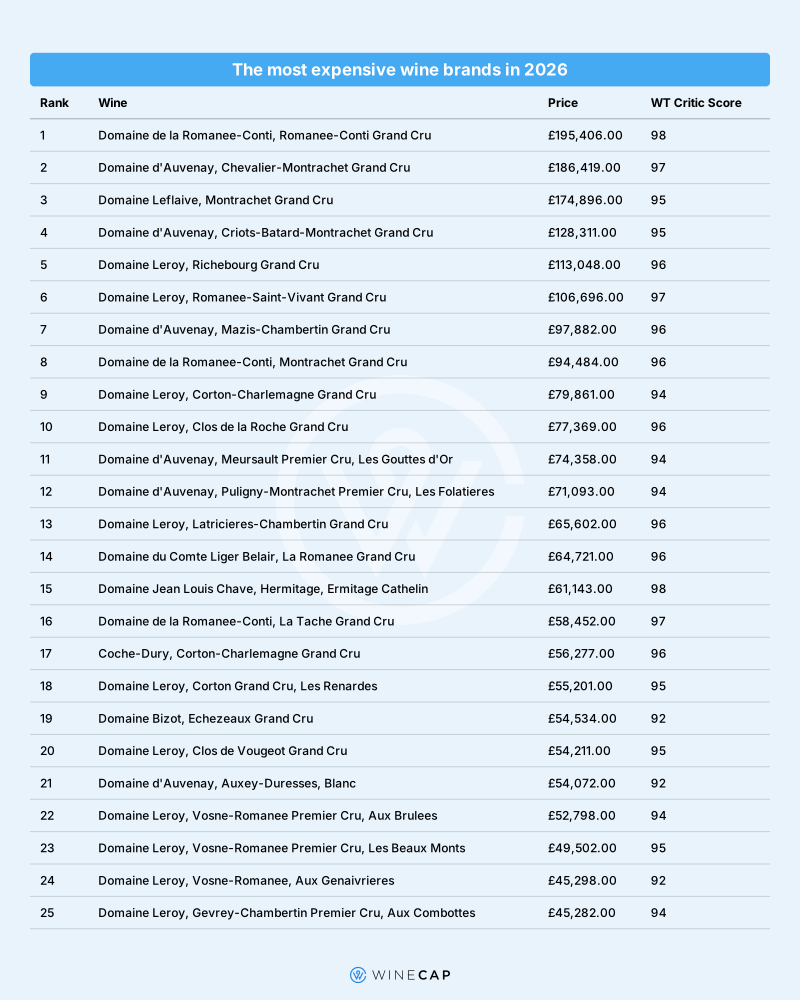
*Average Case Price – Average market price across basket vintages, per 12×75cl.
*Wine Track Critic Score – Aggregate of published third-party critic scores, normalised to 100 points.
*Methodology: Prices represent the average of the best available market prices across recent vintages, exceptionally rare wines are excluded where there is insufficient reliable market data to establish a comparable price.
Two estates by the same owner dominate the ranking
The scale of Lalou Bize-Leroy’s presence becomes clearer further down the ranking. Domaine Leroy contributes 11 wines and Domaine d’Auvenay another six, including Chevalier-Montrachet Grand Cru, the second most expensive wine on the list at £186,419 per 12x75cl case equivalent. Because our methodology intentionally excludes wines for which there is very little data, at least four further wines from Leroy and d’Auvenay are not included on our list. By comparison, Domaine de la Romanee-Conti holds three places, while the remaining five producers appear only once each.
Behind those prices is extreme scarcity. Domaine d’Auvenay farms just 3.87 hectares across 16 appellations, with some parcels producing only a few hundred bottles. Its holding in Criots-Batard-Montrachet, for example, extends to just 0.064 hectares. Production at Domaine Leroy is similarly constrained, combining tiny vineyard holdings with some of Burgundy’s lowest yields.
That scarcity is concentrated around one owner. Bize-Leroy, now in her nineties, farms both estates biodynamically and also retains a 25% share of Domaine de la Romanee-Conti. For collectors and investors, the result is unusual: much of the very top of the fine wine price hierarchy is tied to the output, reputation and eventual succession of a single grower.
Burgundy takes 24 of the 25 places
Only one wine breaks Burgundy’s hold on the ranking. Domaine Jean-Louis Chave’s Ermitage Cathelin, from the northern Rhone, sits fifteenth at £61,143 a case. The next non-Burgundy wine does not appear until 28th place, with Screaming Eagle Sauvignon Blanc from Napa Valley.
The gaps become wider from there. Petrus, the highest-ranked Bordeaux, sits 46th, while Krug Clos du Mesnil is Champagne‘s highest entry at 80th. Italy‘s highest-ranked wine, Soldera Case Basse, does not appear until 99th place.
Burgundy’s dominance at the very top comes as the region is also regaining ground in the broader secondary market. In July 2026, it overtook Bordeaux as the most traded region by value on Liv-ex for the first time since 2022, with DRC, Ramonet, Leflaive and d’Auvenay together accounting for roughly a third of Burgundy trade during the month.
The two measures capture different things. Trading share reflects where activity is taking place across the market; this ranking captures the extreme upper end of pricing. But together they underline Burgundy’s unusual position in 2026: it is home to almost every wine at the top of the price hierarchy while once again attracting a growing share of secondary market trade.
For more on Burgundy, read the WineCap Burgundy Regional Report.
White wine sits at the top of a red region
Red wines make up the majority of the ranking, with 16 of the 25 places. Yet white Burgundy is disproportionately represented at the very top: three of the four most expensive wines are white, as are five of the top ten.
The price difference is equally striking:
- White Burgundy average £102,197 a case, compared with £74,822 for red Burgundy
- The median white wine costs £79,861, versus £59,798 for red
- Whites account for 36% of the wines on the list but 43.4% of its combined value
Scarcity helps explain the premium. The great white Grand Cru vineyards of the Cote de Beaune are exceptionally small, and production becomes smaller still when divided between individual domaines and parcels. At the same time, white Burgundy has proved more resilient than red during the recent market correction. Liv-ex has noted an excess of supply over demand for red Burgundy below £5,000 per case, while better-known whites have been an exception.
The most expensive wine has been the slowest riser
Romanee-Conti Grand Cru remains the most expensive wine in the ranking at £195,406 a case, but it has delivered the lowest ten-year price appreciation of all 25 wines, at 70.9%. By contrast, Domaine d’Auvenay’s six wines have risen by an average of 1,178% over the same period, while Domaine Bizot’s Echezeaux Grand Cru recorded the single largest increase, at over 2,000% in the last decade.
The comparison highlights an important distinction between price and performance. Romanee-Conti began the period from an already exceptional valuation, while some of the wines that have risen fastest were starting from much lower bases. These are also exceptionally scarce wines, where relatively few transactions can produce large percentage movements. The figures therefore describe the performance of a highly selective group rather than Burgundy, or fine wine, as a whole.
The recent picture is more subdued. Seventeen of the 25 wines have fallen over the past twelve months, producing an average decline of 2.0%, while their average six-month movement stands at just +0.4%. That follows the wider Burgundy correction: the Liv-ex Burgundy 150 fell 34% between its September 2022 peak and August 2025, before rising 2.2% from September 2025.
Nor does critical acclaim alone explain the price hierarchy. Chave’s Ermitage Cathelin has the highest Wine Track score on the list at 97.6, yet ranks fifteenth by price. Domaine d’Auvenay’s Auxey-Duresses Blanc has the lowest score, at 91.5, but still commands £54,072 a case after rising 494% over five years. Across the 25 wines, the rank correlation between score and price is 0.55, suggesting that critical quality matters, but scarcity, producer reputation and demand play a substantial role in determining price at this end of the market.
What the world’s most expensive wines tell us about the market
WineCap’s ranking is ultimately as much a measure of scarcity as it is of price. Twenty-four of the 25 wines come from Burgundy, 17 come from two domaines controlled by Lalou Bize-Leroy, and many are produced from vineyard holdings measured in fractions of a hectare. At the very top of the fine wine market, supply can be extraordinarily limited.
But the ranking also shows why price alone is an incomplete measure of investment potential. Romanee-Conti is the most expensive wine on the list but has delivered its lowest ten-year appreciation. Critical scores have only a moderate relationship with price, while some wines are so rarely available that establishing a reliable current market value becomes difficult.
That makes the top of the market very different from the broader Burgundy recovery now emerging on the secondary market. Burgundy may have returned to the largest share of Liv-ex trade by value in July, but the wines in this ranking occupy its narrowest and least accessible end.
Their extraordinary valuations demonstrate the premium the market can place on scarcity and provenance – but also why diversification across producers, regions and price points matters when building a fine wine portfolio.
FAQs: The world’s most expensive wines
What is the most expensive wine in the world in 2026?
Based on WineCap’s Wine Track data as of August 2026, Domaine de la Romanee-Conti’s Romanée-Conti Grand Cru is the most expensive actively traded wine in the ranking, valued at £195,406 per 12x75cl case equivalent.
What are the most expensive wine brands in 2026?
The most expensive fine wine brands are overwhelmingly Burgundian. Domaine Leroy and Domaine d’Auvenay account for 17 of WineCap’s 25 most expensive wines, while Domaine de la Romanee-Conti holds three places.
Why is Domaine Leroy so expensive?
Domaine Leroy combines exceptionally small production with some of Burgundy’s most prestigious vineyard holdings and strong global collector demand. Its wines are produced in very limited quantities, making availability on the secondary market extremely restricted.
Why are Burgundy wines so expensive?
Burgundy’s most sought-after wines come from small, precisely defined vineyards whose production cannot easily be expanded. At the top end, tiny yields, fragmented vineyard ownership and international demand for a handful of producers create significant scarcity premiums.
Is the most expensive wine always the best investment?
No. Romanée-Conti is the most expensive wine in WineCap’s 2026 ranking but recorded the lowest ten-year price appreciation among the 25 wines, at 70.9%. Entry price, liquidity, scarcity and demand all influence investment performance.
What is the most expensive wine outside Burgundy?
Domaine Jean-Louis Chave’s Ermitage Cathelin from the northern Rhone is the only non-Burgundy wine in WineCap’s top 25, ranking fifteenth at £61,143 per case in August 2026.
WineCap’s independent market analysis helps investors build diversified fine wine portfolios with full ownership and transparent pricing. Speak to one of our wine investment experts and start building your portfolio. Schedule your free consultation today.