What is the difference between auction and market prices in fine wine investment
- Auction prices and market prices for fine wine are intrinsically linked yet understanding the distinction is important for valuations.
- Buyer’s premiums of 25% are standard at most major wine auction houses, meaning that the final price a buyer pays is almost always significantly above the hammer price.
- For older vintages, auctions dominate fine wine trading.
For fine wine investors, a wine price can mean different things depending on where you look. An auction price records what a buyer was willing to pay for a particular wine at a particular moment, through a competitive bidding process. A market price, by contrast, is typically derived from the prices at which sellers are currently offering comparable wines on the secondary market.
The two are closely related, but they are not interchangeable. Auction results provide evidence of completed transactions, while market prices offer a broader view of current availability and seller expectations. Both are useful, and both have limitations. Understanding the difference – and knowing which measure to use when – is an important part of valuing fine wine.
What auction prices and market prices actually measure
In economic theory, the market price is the equilibrium point at which supply and demand meet. In fine wine, however, the term is used more practically.
A fine wine market price is typically a derived value based on the asking prices of multiple sellers active on the secondary market. It draws on dozens, and sometimes hundreds, of listings to establish the best available price for a comparable case in perfect, or reliably assumed to be perfect, condition.
It is therefore not the price at which one transaction has necessarily taken place. Rather, it is an aggregate view of what sellers are asking for the wine at a particular point in time – and, by extension, what a buyer could reasonably expect to pay to acquire it.
Platforms such as WineCap aggregate these listings into benchmark prices that act as reference points across the secondary market. Market prices simplify price discovery and reduce search friction for buyers and make comparison straightforward, particularly for younger wines in standard formats with clear provenance.
In economic theory auction prices are simply a way to ascertain a market price. A competitive bidding process sets the price in real time. The hammer falls at the highest bid, and that bid becomes the market price for whatever asset is being sold.
In practice, the two are not synonymous and auction prices can be quite different from market prices. Auctions tend to maximise revenue for rare or scarce assets, because it surfaces the most motivated buyer available on that day. Arguably, that makes auction prices a truer expression of what a specific case of wine is worth at the moment of sale, but is less relevant to the price of another case.
Auction prices tend to be more volatile, are often higher, and are most commonly seen with a narrower set of wines.
The fine wine auction market: who the players are
Wine auctions operate across a well-established hierarchy of houses. Sotheby’s and Christie’s lead the global auction market broadly, with significant wine departments. For wine specifically, an additional group of specialist auctioneers accounts for the largest share of trading volume. Most auctioneers announce their sales figures in US dollars.
- Acker Merell and Condit: $200 million (approximately £157 million) in sales in 2025
- Sotheby’s $127.5 million (approximately £100 million) in sales in 2025
- Zachys: $93.9 million (approximately £74 million) in sales in 2025
- Hart Davis Hart: $87.2 million (approximately £69 million), 19.5% buyer’s premium
- Christie’s: $89 million (approximately £70 million) in sales in 2025
While Bonhams has a wine department, they do not disclose their total wine sales. Online platforms have also expanded the market. iDealwine, a France-based specialist, generated $68 million (approximately £54 million) in 2025 sales. Bid for Wine, owned by Dreweatts, is a regional British auctioneer and operates a comparable digital model in the UK.
The cost of buying and selling at auction
Auction prices require careful translation before any comparison with market prices. The hammer price (the final bid at which a lot is sold) is not what the buyer pays, and it is not what the seller nets. Both sides face additional costs that can be very significant.
Buyers must add a premium to the hammer price. At most major wine auction houses, this runs at 25%, though Hart Davis Hart charges 19.5% and iDealwine charges 26%. On a case selling for £10,000 at the hammer, a 25% buyer’s premium means a total cost of £12,500 before any delivery or storage charges.
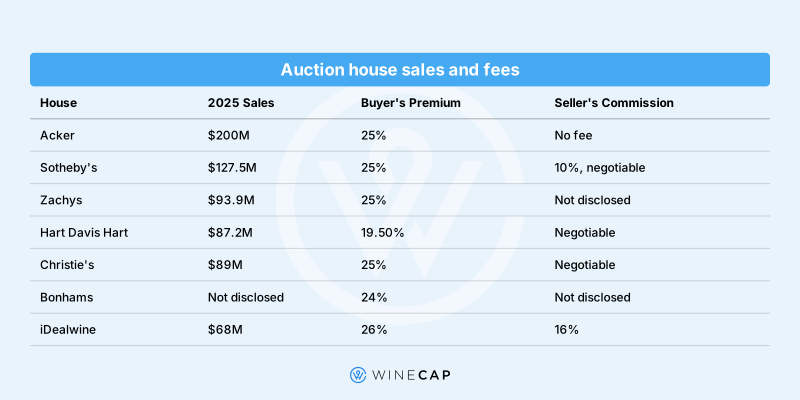
The picture for sellers is more opaque. Houses rarely disclose their commission rates upfront, and rates are almost always negotiable. Acker has set itself apart by charging no seller’s commission, a large part of the reason that they have grown in popularity and revenue. For attractive collections, auction houses compete actively for consignment, with seller’s fees being the major area of negotiation. A seller with a large holding of attractive wines can negotiate seller’s commission to zero. In the most competitive cases, a seller may even secure a proportion of the buyer’s premium, receiving more than 100% of the hammer price as a net return.
Why auction prices are more volatile than market prices
Auction results for the same wine can vary significantly. Condition and provenance (verifiable storage history and ownership chain) drive much of that variability. In the secondary market, younger wines sold in bond carry implied provenance: the storage record is clean by definition. At auction, bottles of varying age and condition compete for buyers who may hold very different views of the same lot.
For instance, in March 2023, three major auction houses sold Domaine de la Romanee-Conti, La Tache 2009. Including buyers’ fees, Acker achieved a case-price equivalent of £70,000, Zachys achieved £62,500, and Sotheby’s achieved £145,000.
At the time, Liv-ex showed a market price of £69,000 per case for the same wine. Wine quality does not explain the spread: the specification across all three lots was identical. The result reflects the specific bidder composition in each room on each day.
Auction prices to ignore: charity sales and distorted results
Not every auction result belongs in a price analysis. Charity auctions regularly produce figures that bear no relationship to market value. Tax treatment creates a real incentive to bid beyond market rates: in the United States, a donor who bids generously at a charity auction may benefit from a tax deduction that reduces their effective net cost. The psychological premium of supporting a high-profile cause adds a further layer. Charity auction results should be stripped from any serious valuation exercise.
The phenomenon extends well beyond wine. In August 2026, “Chassis Zero”, the first production model of Ferrari’s first electric vehicle, the Ferrari Luce, sold at an RM Sotheby’s charity auction during Monterey Car Week in California for $40 million (approximately £32 million). A standard Luce carries a list price of approximately 550,000 euros (roughly £470,000 at launch). No quality or rarity argument explains that gap.
The same distortion appears within wine. In 2026, Chateau Haut-Brion 1961 sold at Sotheby’s in Hong Kong for a case-price equivalent of £17,500, excluding fees. Ten days earlier, a magnum of the same wine sold at Christie’s in London for a case-price equivalent of £65,000, also excluding fees. The Christie’s sale was a charity event. An investor using that result to value their own bottles would overstate the figure by nearly four times.
When auction is the right marketplace
For older wines, auction is the dominant trading mechanism. Analysis of Chateau Lafite Rothschild across seven prime vintages shows how sharply the ratio of auction trades to Liv-ex secondary market trades shifts with age. The older the wine, the more the auction room dominates as the primary marketplace.
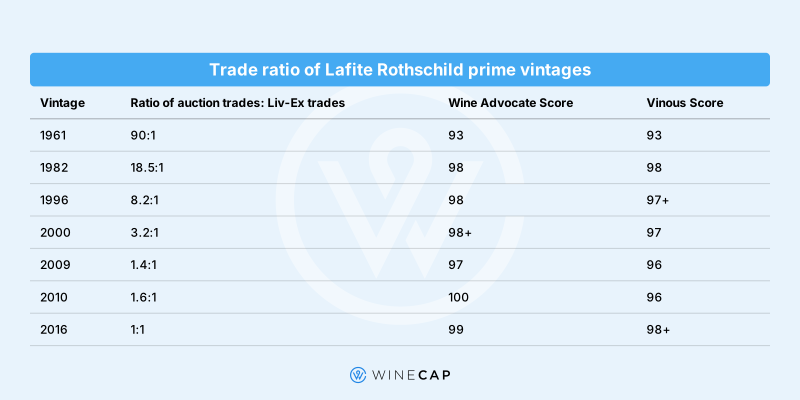
The same pattern holds across high-value, long-lived assets generally. Classic cars, watches, and fine art all see the same migration toward auction as the primary trading mechanism as they age and become genuinely rare. Knowing when to use auction prices as a valuation input, when to rely on secondary market benchmarks, and when to discard a result entirely as an outlier or a charity distortion is a genuine source of edge in this market.
FAQ: Auction vs market prices in fine wine investment
How do I know if an auction result is a reliable market reference?
Check three things before using any auction result as a valuation input: whether the sale was a charity event (if so, discard it), the condition and provenance notes on the lot, and whether multiple comparable results support the figure. A single result tells you far less than the range.
Is auction or the secondary market better for selling fine wine?
It depends on the wine and the vintage. Younger wines in bond with clean provenance typically achieve competitive results on the secondary market at lower transaction cost. Older and rarer bottles trade more actively at auction, where specialist buyers concentrate.
What is the difference between the hammer price and the total cost at auction?
The hammer price is the winning bid, before fees. As a buyer, adding a 25% buyer’s premium to a £10,000 hammer price brings the total to £12,500, before any delivery or storage costs. As a seller, your net return is the hammer price minus any seller’s commission. Sellers of attractive collections can negotiate commissions to zero, or in some cases receive more than the hammer price through a share of buyer fees.
Why are older wines more likely to sell at auction?
As a wine ages, listed secondary market activity falls and auction becomes the primary venue where motivated buyers for rare, old bottles congregate. As our data above shows, that shift is measurable: the 2016 vintage trades equally between auction and Liv-ex, while the 1961 vintage trades at auction 90 times more frequently. Auction provides price discovery for assets with limited comparable transactions, which is precisely what very old fine wine becomes over time.
WineCap’s independent market analysis helps investors build diversified fine wine portfolios with full ownership and transparent pricing. Speak to one of our wine investment experts and start building your portfolio. Schedule your free consultation today.