Top Right Bank Bordeaux estates: An investor’s guide to Pomerol and Saint-Emilion
- Right Bank Bordeaux estates, led by Petrus and Le Pin, rank among the most expensive wines in the world.
- Saint-Emilion is the largest appellation in Bordeaux; Pomerol is the smallest: both operate without a fixed classification, creating different investment dynamics.
- The Saint-Emilion classification has been contentious for over two decades, with three of its most prestigious estates withdrawing from the system entirely.
Right Bank Bordeaux operates on different terms from the Left. The dominant grape is Merlot, the soils are clay and limestone rather than gravel, and the estates are generally smaller, sometimes dramatically so. The two appellations that matter most to investors are Pomerol and Saint-Emilion. Both sit close to the medieval town of Libourne on Bordeaux’s eastern side, and both produce wines that compete at the top end of the secondary market. Understanding the differences between them, and which producers stand apart within each, is where the investment case begins.
Right Bank vs Left Bank: A different wine, a similar market
The Left Bank of Bordeaux is Cabernet Sauvignon country. The great estates of the Medoc, including Chateau Lafite Rothschild, Chateau Latour, and Chateau Margaux, sit on gravel beds that drain quickly and warm in summer sun, creating ideal conditions for Cabernet ripening. Cross the Gironde and Dordogne rivers to the Right Bank and the terroir changes fundamentally. Clay and limestone soils retain moisture and ripen Merlot more readily than Cabernet. The result is wines that tend toward softness and richness, though the finest age just as impressively as any classified left bank growth.
The Right Bank encompasses several other appellations, including Blaye, Bourg, Fronsac, and Entre-Deux-Mers. These produce decent wine but lack the secondary market presence that makes fine wine investable: no significant price history, no meaningful auction activity, no collector demand of the depth required. This article addresses only Pomerol and Saint-Emilion, the two Right Bank appellations with genuine investment credentials.
In terms of pure investment performance, the Left Bank and Right Bank offer similar dynamics. Over the last thirty years the Left has been a little more responsive to changing conditions and tends to see greater growth, while the Right has been more resilient. Overall, however, the performance has been relatively even between the two.
Saint-Emilion and Pomerol: Size, grapes, and geography
Pomerol and Saint-Emilion make a contrasting pair. Pomerol is the smallest appellation in Bordeaux, covering around 800 hectares of gently rolling clay plateau north-east of Libourne, with no grand chateau architecture and no official classification. Saint-Emilion is the largest appellation in Bordeaux at roughly 5,500 hectares, with a UNESCO-listed medieval town at its centre, a classification system revised approximately every decade, and a range of estates stretching from genuinely world-class to merely Grand Cru in name.
Both appellations grow primarily Merlot, supplemented by Cabernet Franc. In Pomerol, Merlot can account for 95% or more of a blend on the finest estates. The dense blue clay soils around Pomerol’s plateau retain moisture and nutrients in a way that produces wines of extraordinary concentration and depth. Saint-Emilion’s geology is more varied: the limestone plateau around the town yields wines of structure and elegance, while the lower slopes and gravelly terraces produce softer, more accessible styles, including the distinctive Cabernet Franc-dominant wines of Chateau Cheval Blanc and Chateau Figeac.
How the Saint-Emilion classification works
The Medoc’s classification has remained almost entirely unchanged since Napoleon III commissioned it, with the 1973 promotion of Mouton Rothschild from Second to First Growth the only significant exception. In contrast, Saint-Emilion reviews its classification roughly every decade, with the most recent revision in 2022. The stated aim is to reflect current quality rather than purely historical reputation.
The classification runs in three tiers. At the top, Premier Grand Cru Classe A estates form the smallest and most prestigious group, while Premier Grand Cru Classe B covers a larger and more diverse set of estates. A broader Grand Cru Classe designation covers much of the rest of the appellation while below that and outside of the formal classification lie a further 200+ wines that carry the description “Grand Cru”. For investors, the A tier and the handful of the B tier estates are where secondary market concentration lies.
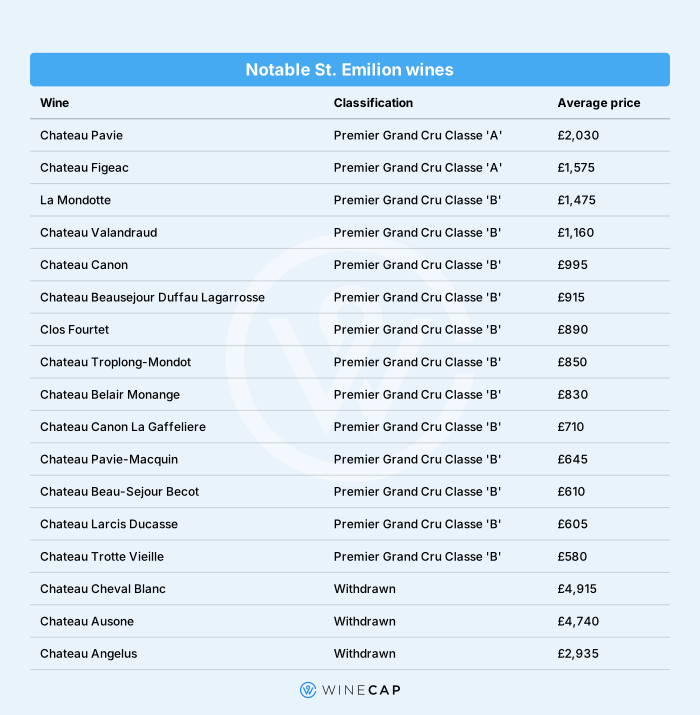
The controversy that has surrounded the Saint-Emilion classification
With classification having meaningful financial consequences for estates, it has become a persistent source of dispute. Legal challenges began in earnest with the 2006 revision, and the 2012 classification drew sustained controversy, including court action from estates that disputed the methodology. More seriously in 2021 a French court found the owner of Chateau Angelus Hubert de Bouard, guilty of exercising undue influence over the 2012 classification process.
The reputational damage to the classification became more serious ahead of the 2022 revision. Citing concerns about the process and its integrity, Chateau Ausone and Chateau Cheval Blanc announced their withdrawal from the classification entirely. Chateau Angelus also withdrew citing the unfair denigration of the classification system and the toxic environment around it.
Chateau Figeac was promoted to Premier Grand Cru Classe A in the 2022 revision, alongside the continuing presence of Chateau Pavie. The result is a classification in which some of the appellation’s finest properties sit outside the official hierarchy while others remain within it, and in which collector demand pays limited attention to the distinction.
Unlike in 2012 when promotion turbocharged already rising prices for Angelus and Pavie, Figeac’s 2022 promotion coincided with the market stalling and plateauing values.
Pomerol’s elite: The estates that define the appellation
Pomerol’s top wines compete with any wine in the world on price, liquidity, and collector demand. With the exception of Vieux Chateau Certan, which farms around 14 hectares and represents a relatively more accessible entry into the tier, the estates below are small producers on tiny plots of land. Two command prices that rank among the most expensive wines made anywhere: Petrus and Le Pin.
Petrus
The most celebrated name in Pomerol, farming 11 hectares of almost pure blue clay planted almost entirely to Merlot.
- Annual production is around 4,500 cases from 11 hectares.
- Best vintages include 2000, 2008, 2009, 2010, 2015, and 2019.
- Average market price: £30,000 per case
Le Pin
One of 20+ estates owned by the Thienpont family, this is the jewel in their crown and one of the rarest wines in Bordeaux.
- Approximately 2 hectares, producing fewer than 700 cases per year
- Best vintages include 1982, 2005, 2009, 2012, and 2019.
- Average market price: £26,000 per case.
Vieux Chateau Certan
Owned by the Thienpont family since the 1920s and known as VCC, scores here often compete with Le Pin and Petrus at much lower prices.
- Annual production of just under 5,000 cases from 14 hectares
- Reliable across most good vintages; 2016 and 2019 are outstanding.
- Average market price: £1,800 per case.
L’Eglise Clinet
Denis Durantou utterly transformed this producer over a 40 year tenure until his death in 2020. His daughters have continued his work producing a wine that is well loved by critics.
- Around 5 hectares produce on average 1250 cases per year.
- Best vintages include 1998, 2005, 2009, 2016, 2019.
- Average market price: £1,650 per case.
Pomerol’s second tier estates
Lafleur occupies an unusual position. From the 2025 vintage, it is no longer a Pomerol wine: the estate withdrew from both the Pomerol AOC and the broader Bordeaux designation, becoming a Vin de France. Its profile remains almost as high as Petrus and Le Pin. In good vintages, prices reach comparable levels. The key difference is volatility: Lafleur’s prices swing more dramatically from vintage to vintage than either Petrus or Le Pin.
Trotanoy is the classic estate that competes without yet quite having arrived. Quality and price place it in the same conversation as Vieux Chateau Certan and L’Eglise Clinet, but it has not achieved the same secondary market depth or collector cachet.
Below this level some estates remain investable, though with more selective market activity and lower overall liquidity making them less favorable than other more prominent options:
- La Conseillante: Elegant, consistently reliable Pomerol with strong critical support and reasonable secondary market presence.
- Fleur-Petrus: Moueix family ownership (the same family behind Petrus) lends brand recognition that supports trading activity from collectors new to the appellation.
- L’Evangile: Owned by Domaines Barons de Rothschild (the Lafite family) since 1990, with investment in quality that has raised the estate’s profile steadily.
- Clinet: Small production and strong scores in top vintages; occasionally trades above what its broader profile suggests it should.
- La Violette: Tiny production and a growing collector following, with prices that have risen sharply in recent years relative to the estate’s starting point.
- Clos L’Eglise: Frequently overlooked, producing dense, concentrated wine that can offer relative value at entry level.
- Gazin: One of the larger Pomerol estates at around 24 hectares, offering broader accessibility and a degree of secondary market consistency.
Saint-Emilion’s defining estates: The Classe A wines
Five estates have defined the upper tier of Saint-Emilion, though the classification status of each has shifted. Chateau Ausone, Chateau Cheval Blanc, and Chateau Angelus have all withdrawn from the classification in recent years. Chateau Pavie and Chateau Figeac (promoted to Classe A in 2022) remain within it. Withdrawal from the classification has not meaningfully affected collector demand: secondary market pricing for Ausone and Cheval Blanc remains among the strongest of any Bordeaux estate outside the 1855 First Growths.
Chateau Ausone
One of Bordeaux’s most distinctive wines from its limestone escarpment above Saint-Emilion town, its unique terroir make it among the most sought after wines in Bordeaux.
- Tiny production of around 1,800 cases per year from 7 hectares.
- Best vintages include 2005, 2009, 2010, 2015, 2019.
- Average market price: £4,750 per case.
Chateau Cheval Blanc
Owned by luxury goodsbehemoth LVMH CHeval Blanc farm an unusually high proportion of Cabernet Franc from one of the largest estates on the Right Bank.
- 39 hectares produce around 8,000 cases annually.
- Best vintages include 2000, 2005, 2009, 2010, 2015, 2016.
- Average market price: £4,900 per case.
Chateau Angelus
With their iconic bell Angelus has become one of the best known St Emilion wines, and like Pavie saw prices climb significantly in the years around their promotion to Grand Cru Classe A in 2012.
- Of their larger holdings only 27 hectares can be used for the Grand Vin to produce around 7,000 cases per year.
- Best vintages include 2000, 2005, 2009, 2012, 2016.
- Average market price: £2,900 per case.
Chateau Pavie
Former supermarket magnate Gerard Perse purchased Pavie in 1998, after his death in 2025 responsibility was taken by his daughter Angelique and her husband.
- Here around 35 hectares produce on average around 6,500 cases per year.
- Best vintages include 2000, 2005, 2009, 2010, 2016.
- Average market price: £2,030 per case.
Chateau Figeac
The newest entry to St. Emilion’s top tier, Figeac’s promotion was widely expected and came after a decade of rising prices.
- 54 hectares of gravelly soils make a little more than 8,000 cases per year.
- Best vintages include 2000, 2009, 2015, 2016, 2022.
- Average market price: £1,575 per case.
Saint-Emilion Premier Grand Cru Classe B: Three wines worth watching
Twelve estates currently hold Premier Grand Cru Classe B status. For investors, three stand apart for secondary market presence, critical support, and overall investable profile.
Canon
The most significant of the three, and the most consistent performer. Chanel (through the Wertheimer brothers) has owned the estate since 1996. Chanel also owns Chateau Rauzan-Segla in Margaux.
- Approximate secondary market price: £995 per case
Troplong Mondot
Acquired by French reinsurance company SCOR in 2017, with Aymeric de Gironde appointed to lead the estate. The new direction has drawn substantially improved critical reception.
- Approximate secondary market price: £850 per case
Beausejour Duffau-Lagarrosse
6.5 hectares of clay-limestone soils on the western plateau, producing wines of genuine structure and longevity.
- Approximate secondary market price: £915 per case
Why invest in Bordeaux Right Bank wines?
Pomerol and Saint-Emilion present distinct propositions. Pomerol offers no classification, tiny estates, and some of the world’s highest per-bottle prices, driven by scarcity that is structural rather than manufactured. Saint-Emilion offers a broader price range, a classification system that creates opportunity and noise in equal measure, and a set of estates where critical momentum and ownership changes have been shown to drive value shifts.
For investors, the most durable positions in both appellations rest on the same foundation: small production, consistent quality, and collector demand that outpaces available supply.
FAQ: Right Bank Bordeaux investment
What is the difference between Pomerol and Saint-Emilion for investors?
For investors the distinction is largely about price points. For entry-level investment in the Right Bank, Saint-Emilion offers more choice; for long-term holdings at the highest level, Pomerol’s top estates have few rivals.
How much does Petrus cost on the secondary market?
Petrus sits among the most expensive wines in Bordeaux, with secondary market prices varying significantly by vintage. Average value of above £30,000 per case can rise to £100,000 in large formats and strong vintages and only a handful of poorer young vintages are available for less than £25,000 per case.
Does the Saint-Emilion classification matter for investors?
Classification status influences market perception, but the 2022 controversy demonstrated that it does not in isolation determine collector demand. For investors, producer quality, production volume, and secondary market liquidity are more reliable indicators than classification tier alone.
How liquid is Right Bank Bordeaux on the secondary market?
Liquidity varies considerably across the tier. Petrus, Cheval Blanc, and Le Pin trade regularly at auction and on platforms including Liv-ex despite lower production volume than their Left Bank cousins. Below the top tier, investors in second-tier Pomerol or Saint-Emilion Classe B estates should expect longer selling timelines which makes position sizing and entry price more important decisions.
What are the best vintages for Right Bank Bordeaux investment?
Across both Pomerol and Saint-Emilion, the years most consistently cited by collectors and the secondary market include 2000, 2005, 2009, 2010, 2015, 2016, and 2019. The 2016 vintage is particularly notable for Saint-Emilion but as is the case elsewhere, lesser vintages can provide outsized returns, although longer term holds should still favor the best quality.
WineCap’s independent market analysis helps investors build diversified fine wine portfolios with full ownership and transparent pricing. Speak to one of our wine investment experts and start building your portfolio. Schedule your free consultation today.