The 2000 vintage in Bordeaux, Burgundy and beyond
- Left Bank Bordeaux is the standout fine wine region of the 2000 vintage and one of the finest of the modern era, with wines that are only now reaching their drinking peak.
- Bordeaux 2000 consistently trades above comparable quality years, driven by the date as much as the wine.
- 2000 was not a universal success, with Burgundy reds, California Cabernet, and Germany all falling short.
In 2026, the 2000 vintage is three stories in one. The first is a quality story: Left Bank Bordeaux, Piedmont, and Port all delivered wines of genuine distinction. The second is a marketing story: the cultural significance of the number on the label attracted buyers motivated by the date as much as by the wine. Third is the question “is this vintage still investable” to which the answer is yes, but with some caveats. Twenty-five years on, the millennium premium remains embedded in prices, particularly in Bordeaux. Separating genuine quality from commercial cachet is the starting point for any investor approaching this vintage today.
How good was the 2000 vintage?
Vintages give investors a probability framework, not a guarantee. A strong growing season raises the quality floor across a region and improves the odds of success for individual wines. 2000 produced some of the finest Left Bank Bordeaux of the modern era while delivering disappointing Burgundy reds, weak German Riesling, and compromised California Cabernet. That spread is wider than most celebrated years. The aggregate score for a vintage still matters; individual wine selection always matters more.
What made 2000 a great growing season and where
The late oenologist Denis Dubourdieu identified four conditions that reliably produce a great Bordeaux vintage. The same criteria, adapted for local conditions, apply across virtually every fine wine region in the world.
- Early and rapid flowering, producing even berry development across the crop
- Gradual water stress in July, slowing vine growth and concentrating the fruit
- Warm, dry conditions through August and September, building phenolic (flavour and tannin) ripeness without heat damage
- A dry harvest period, giving producers the flexibility to pick at optimal maturity
Bordeaux broadly satisfied all four criteria in 2000. The season was warm and gradual, building concentration without the heat extremes that damaged 2003.
Two regions illustrate what happens when the criteria are not met. California’s North Coast failed criterion four: a cold, rainy October disrupted harvest and prevented full phenolic ripeness for late-ripening red varieties. Robert Parker scored North Coast Cabernet just 78 points for 2000, the lowest of any major region in his vintage chart.
Burgundy failed criteria three and four. Prolonged rain and rot during August and the harvest period produced a large, dilute crop across the Cote de Nuits. The conditions that generate precision and concentration in Pinot Noir were simply not present.
Bordeaux 2000: A Left Bank classic
Bordeaux 2000 is, above all, a red wine story. The Left Bank appellations (Pauillac, Saint-Julien, Saint-Estephe, Margaux, and Pessac-Leognan) produced wines of exceptional concentration and structural precision, although they have been eclipsed in terms of outright quality since, at the time they were a very real highpoint. Contemporary critics such as Robert Parker and Wine Enthusiast magazine scored the principal Medoc appellations between 96 and 97 points, with Wine Enthusiast also awarding Pomerol 97 points.
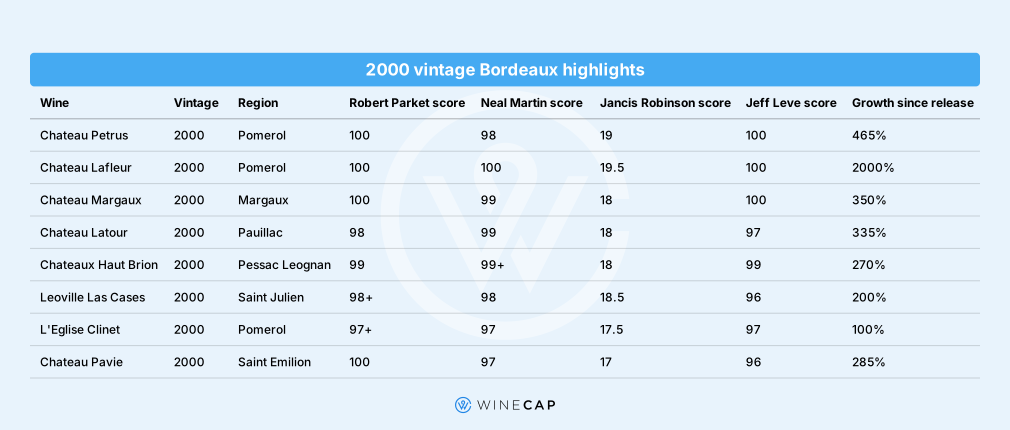
Pavie is perhaps the most debated wine of the vintage. Under Gerard Perse, who acquired the property in 1998, the 2000 was made in a highly extracted style that divided critics. However, even critics like Neal Martin, who question how it interprets the terroir of Saint-Emilion have been fairly uniform in their praise. For investors, that score is the relevant input, whatever view one takes on the stylistic question.
Chateau Mouton Rothschild 2000 occupies a special position in the vintage, as its scores didn’t quite meet up to the level of its First Growth peers but it was the first classified growth Bordeaux to use a fully gold-embossed bottle, marking the millennium. That presentation set a template for others and transformed the bottle into a collector object in its own right. Mouton 2000 prices, around £15,000 a case today, have risen 800% since release with large formats doing even better, often trading at a 20-30% premium over cases.
Other examples of similar bottlings include Angelus 2012, Margaux 2015, Cos d’Estournel 2020, Leoville Poyferre 2020 and Gruaud Larose 2025. None have done so with quite the same panache as Mouton Rothschild and only Angelus has seen similar performance.
The most important point for investors is timing. These wines are only now entering the best part of their drinking windows. For the finest Left Bank examples, that window extends comfortably to 2035 and beyond. Owning them at this stage means genuine pleasure ahead as well as potential value.
The millennium premium: Bordeaux 2000 vs 2005
In this instance in particular the vintage on the label carries price weight that quality metrics alone do not explain. Bordeaux 2000 consistently trades above comparable quality years. The clearest example is when comparing 2000 to the 2005 vintage.
Both are outstanding vintages, yet across a basket of Bordeaux First Growth, Second Growths, St Emilion Grand Cru Classe A’s and top Pomerol 2000 trades at nearly 15% higher prices, and across 25 wines in only 3 cases is 2005 more costly (Haut Brion, Ducru Beaucaillou and Lascombes).
Burgundy 2000: a vintage to approach with caution
Burgundy’s red 2000s are not a collector vintage at the broad level. Rain and rot during August and the harvest period produced a dilute crop across the Cote de Nuits. Parker scored Cote de Nuits reds at 87 points; Wine Enthusiast rated them 84. In a region where the finest years set the benchmark, 2000 falls well short.
White Burgundy fared somewhat better. The complicating factor is what is now recognised as the pre-mox era: a period from roughly the mid-1990s to the mid-2000s during which premature oxidation (a fault caused by insufficient oxygen protection, often linked to poor-quality cork) affected a significant proportion of white Burgundy production, turning wines brown and flat well before their intended drinking windows. At 25 years old, a meaningful number of white Burgundy 2000s will have oxidised.
Italy 2000 and Vintage Port 2000
Piedmont 2000 was another strong year in a consecutive run of excellent vintages. The finest examples are in a sweet spot now: complex and evolved, with years of life remaining. Some late October rains affected producers who left Nebbiolo hanging longest, so producer selection matters. These wines, unlike their Bordeaux equivalents, carry no Millennial price premium, which makes the relative value case compelling.
Tuscany in 2000 was more variable. An extremely hot August raised concerns about overripeness, and not every producer navigated the conditions well. Top producers made good to very good wines, but the vintage does not offer the broad quality floor that justifies buying across the appellation.
Port 2000 was exceptional and widely declared. Yields fell by as much as 40%, concentrating the remaining fruit. Port remains a niche investment category relative to Italy, but collectors with an interest in the style have a strong reference point in this vintage.
Champagne 2000: Cristal, Dom Perignon and Krug
Unsettled growing conditions led many major houses to decide against a wine for the 2000 vintage. Yet a significant number of prestigious producers did release their tetes de cuvee (prestige flagship cuvees), signalling genuine confidence in their individual harvest results. These included:
- Dom Perignon (and Dom Perignon Rose)
- Louis Roederer Cristal (and Cristal Rose)
- Krug
- Taittinger Comtes de Champagne
- Bollinger Vieilles Vignes Francaises and Grande Annee
- Pol Roger Sir Winston Churchill
- Billecart-Salmon Nicolas Francois Billecart
- Philipponnat Clos des Goisses
- Lanson Noble Cuvee
Many of these have been considerable investment successes with the Millennial date amplifying demand for wines that stood on its own quality merits. For instance, Dom Perignon 2000 has risen 200% since release. Cristal has been the greatest success with prices up 430% since release in 2007.
2000 at 25: Rarity, drinking windows, and what to buy now
Twenty-five years after the harvest, the finest 2000 wines are only now finding their stride. Left Bank Bordeaux at this age is not in comfortable decline. For the greatest examples, the drinking window runs from now to 2035 and well beyond. These bottles carry genuine pleasure ahead of them, which adds secondary market support as serious collectors seek access to mature, well-stored examples.
The Millennial premium is not fading. Bordeaux 2000 continues to trade above comparable quality years, sustained by collector demand the label independently generates. For those considering entry, careful comparison against adjacent vintages remains prudent.
Age creates its own requirements. At 25 years, provenance and condition are paramount. Capsule integrity, label condition, and documented storage history all matter: buyers discount heavily at auction for anything unverifiable. Large formats (magnums and double magnums) merit attention here. They age more slowly, remain at peak condition for longer, and command a growing premium as they become increasingly scarce.
The investment case for 2000 now concentrates at the very top. These are wines where provenance, critical track record, and structural integrity give genuine confidence in another two decades of development. Liquidity will diminish as bottles are consumed. The counterweight is rarity: a case of Left Bank Bordeaux 2000 in 2035 or 2045 will be a fundamentally different object from what it is today.
FAQ: 2000 vintage wine investment
Is 2000 Bordeaux still worth buying at current prices?
The quality case for 2000 Left Bank Bordeaux remains intact: these are outstanding wines now entering their drinking peaks, with a long window ahead. The price question is more nuanced: Bordeaux 2000 trades at a premium to comparable quality years but that premium appears durable.
Which wines from the 2000 vintage have the strongest investment case?
Within Bordeaux, the strongest case is for the great Left Bank estates where critical scores are unambiguous and drinking windows remain long. In Italy, the finest Barolos represent genuine quality without the Millennial price premium. In Champagne the prestige cuvees are the core investable wines, although their drinking windows will not be as long as Bordeaux.
How important is provenance when buying 2000 wines?
Provenance is critical at this age. Twenty-five years of storage create risk: heat damage, inconsistent cellaring, and poor handling all affect quality significantly. A verifiable storage record in bond reduces that risk substantially.
Are large formats worth the premium for 2000 wines?
Yes, for long-term holders. Magnums and double magnums age more slowly than standard bottles, meaning the wine remains at peak condition for longer. At auction, magnum premiums for great vintages tend to expand as rarity increases.
WineCap’s independent market analysis helps investors build diversified fine wine portfolios with full ownership and transparent pricing. Speak to one of our wine investment experts and start building your portfolio. Schedule your free consultation today.