Can you invest in fortified wine? Port, Sherry and Madeira explained
- Fortified wine covers Port, Sherry and Madeira, three categories that share one technique but create scarcity in entirely different ways.
- You can invest in fortified wine, though only Port has a published index, which keeps most holdings small and slow to sell.
- Collectable value rests on bottles that cannot be remade: fixed vintage declarations, drawn-down soleras and aged Madeira that is still drinkable.
Fortified wine produces the longest-lived bottles in the wine trade and the least understood by investors. Port, Sherry and Madeira share one technique, the addition of grape spirit, but they are made differently, age differently and trade differently. This guide explains how each one works, sets out the differences that matter, and shows why fortified wine tends to occupy a small corner of a portfolio while producing some of the most collectable bottles in existence.
What fortified wine is, and why three names dominate
Fortified wine is wine with grape spirit added to it. The addition raises alcohol content, usually to somewhere between 15% and 22%, and it transforms how long the wine survives. That longevity is what makes the category interesting to a collector, because it is the reason genuinely old bottles are available to buy at all.
The practice began as preservation. Wine shipped from Portugal and Spain to northern Europe spoiled on the voyage, and added spirit kept it drinkable. Producers then found the additions improved the wine rather than merely protecting it, and three regions built distinct traditions around the technique.
- Port comes from the Douro valley in northern Portugal. Producers add spirit part-way through fermentation, which stops the yeast and leaves natural grape sugar in the wine.
- Sherry comes from Jerez in southern Spain. Producers ferment the wine dry first and fortify it afterwards, so the base wine is nothing like Port.
- Madeira comes from the Atlantic island of the same name. Producers heat the wine deliberately, which sounds destructive and is the reason Madeira outlives everything else.
Those three account for almost all collector interest. Marsala, Vermouth and Commandaria use the same technique, but they trade in negligible volumes and have no established secondary market.
Port depends on the vintage a house chooses to declare
Port has the simplest structure of the three, and that simplicity is why it dominates trading. In years a house judges exceptional, it declares a vintage, meaning it bottles that year on its own rather than blending it away. Declarations happen roughly three times a decade.
The decision fixes supply permanently. Once a house has declared and bottled, no more of that vintage can ever exist, and every bottle opened reduces what remains. Producers declared 2016 and 2017 back to back, an unusual sequence, then declared nothing generally until 2024.
Five houses carry most of the trade: Dow, Fonseca, Graham, Taylor and Warre. Below declared vintages sit Single Quinta Ports, made from one estate in undeclared years and priced lower, and Late Bottled Vintage Port, made in commercial volumes for early drinking. Only the first two have collector relevance.
Aged tawny and colheita Ports sit outside that hierarchy. Producers mature them in cask until they are ready to drink, so they arrive at maturity on release and appeal to drinkers rather than to collectors.
Sherry is aged in a solera, so it has no vintage
Sherry uses a system that makes vintage dating impossible, and that single fact explains most of its market behaviour. A solera is a stack of barrels holding wine of different ages. Producers draw a portion from the oldest barrels, top those up from the next oldest, and repeat down the chain, so every bottle blends many years together.
The result is an average age rather than a date. Two certifications mark the oldest stock: VOS (Vinum Optimum Signatum) for an average age of at least 20 years, and VORS (Vinum Optimum Rare Signatum) for at least 30 (Consejo Regulador). The Consejo verifies both through laboratory analysis and tasting assessment.
Styles vary more widely than in Port or Madeira. Fino and Manzanilla age beneath a film of yeast called flor, which keeps them pale and dry. Amontillado, Oloroso and Palo Cortado age in contact with air and darken as they do. Pedro Ximenez is sweet and intensely concentrated. Only the oxidative styles and Pedro Ximenez carry VOS or VORS certification, which is where collector attention sits.
For a buyer, this creates a comparison problem. A collector can compare two bottles of 1994 Taylor directly. Comparing two VORS Olorosos means comparing two blends nobody can decompose, from bodegas whose reputations differ. Old solera stock is scarce since producers cannot replace what they draw down, but scarcity without comparability makes pricing difficult.
Madeira is heated on purpose and survives almost indefinitely
Madeira’s production would ruin any other wine. Producers either warm it in heated tanks for months, a process called estufagem, or leave it in casks in warm lofts for years or decades, known as canteiro. Both methods expose the wine to heat and oxygen.
Oxidation is what normally kills wine. Madeira has already been through it, so little remains for time to damage. Bottles from the eighteenth century still open sound, which is true of no other wine category.
Grape variety signals style, and older bottles are usually labelled by grape rather than by house style. Sercial is the driest, followed by Verdelho, Bual and Malmsey, which is the sweetest. Tinta Negra accounts for most volume production. Collector attention concentrates on the four noble varieties.
That produces an unusual market. Antique Madeira exists in drinkable condition in a way old Bordeaux does not, so a collector buying a very old bottle can expect it to be alive. Colheita Madeira, from a single year and aged at least five, and vintage Madeira, aged at least twenty, offer the same durability at far lower prices.
How long can fortified wine age
Ageing potential varies more across these three categories than anywhere else in wine. The spans below matter to a buyer for two reasons: they determine how long a bottle can be held before selling, and how quickly it has to be drunk once the cork comes out.
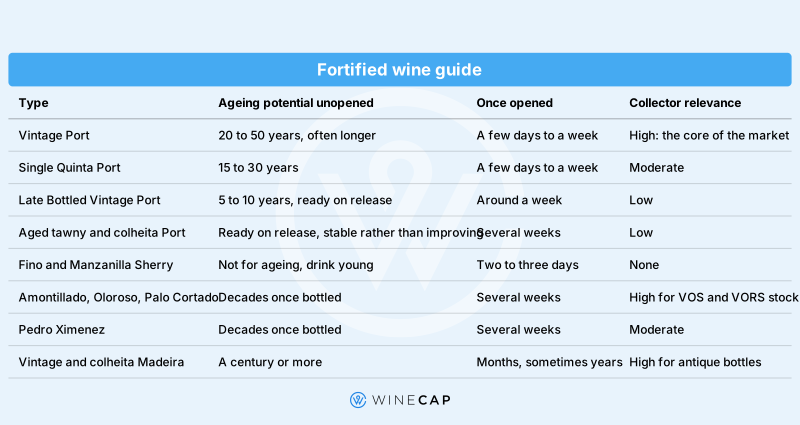
How fortified wines create scarcity
Scarcity is the common thread, and each category manufactures it differently. Knowing which mechanism applies tells a buyer more than any general view on fortified wine does.
- Port restricts supply by decision. A house declares or it does not, and once bottled the quantity is fixed. Scarcity is set at the outset and erodes as bottles are drunk.
- Sherry restricts supply by consumption of the solera. Old stock disappears into bottles and cannot be recreated, because recreating it would require the decades to run again.
- Madeira restricts supply by survival. Antique bottles are scarce because few were kept rather than because few were made, and the wine’s durability means the survivors remain viable.
Those mechanisms produce different market behaviour. Port has dates, named houses and comparable sales, which supports a functioning secondary market. Sherry has certified ages and reputations, which supports specialist trading. Madeira’s antique tier behaves like an antiques market, moving when a cellar comes to auction rather than with wine prices generally.
Why fortified wine stays a small part of a portfolio
Liquidity is the binding constraint across all three categories. Selling fine wine requires a buyer who wants that specific bottle, and fortified wine has far fewer of them than Bordeaux or Burgundy. Port is the only category with a published index. Liv-ex launched the Port 50 in October 2018, tracking the ten most recent vintages from the five main houses.
Moreover, HMRC’s Capital Gains Manual states that the wasting-asset exemption, which covers assets with a predictable life of 50 years or less, would not apply to Port and other fortified wines given their long storage life (HMRC, CG76901). The longevity that makes these wines collectable is the reason they fall outside a treatment some still wines can rely on. Treatment depends on individual circumstances and may change, so take independent tax advice.
The collectable case rests on bottles that cannot be remade
Collector demand is where fortified wine looks strongest, and it comes from rarity rather than from market momentum.
Results at the top of the Madeira market show what that rarity attracts. A bottle dated to around 1715 sold for roughly $39,000 in 2016, and a nineteenth-century Liberty Hall bottling reached close to $16,000 at Christie’s in 2018. These are selected examples from the very top of the market rather than representative Madeira prices.
Condition determines much of what a buyer will pay. Vintage Port is bottled unfiltered and throws heavy sediment, so undisturbed storage matters more here than in most categories. Original cases, intact capsules, legible labels and an unbroken bonded storage record all feed into price, and a bottle without documentation sells at a discount whatever the vintage.
How to buy fortified wine for the long term
Buying well matters more than timing here, because the exit can be slower than more liquid fine wines across all three categories.
A sensible approach would be:
- Start with declared vintage Port from one of the five main houses.
- Treat Single Quinta Port and VORS Sherry as smaller positions.
- Buy aged Madeira only where provenance and condition are documented.
- Store everything in bond, with condition records and an unbroken storage history.
- Take independent tax advice before assuming any particular treatment applies.
Fortified wine complements a core holding in Bordeaux, Burgundy or Champagne rather than substituting for any part of it.
What fortified wine offers
Fortified wine gives a collector access to something the rest of the wine world cannot supply: bottles that are genuinely old and genuinely drinkable. A nineteenth-century Madeira is not a curiosity kept for display. It works, which is why a small group of buyers pursues it regardless of what fine wine indices are doing.
What it asks in return is patience and effort. The research burden falls on the buyer, published pricing barely exists outside Port, tax treatment is less favourable than for some still wines, and selling takes time. Those costs are why fortified wine belongs at the edge of a portfolio rather than the centre, and also why its rarest bottles keep finding buyers.
FAQ: Fortified wine investment
What counts as fortified wine?
Fortified wine is wine with grape spirit added, which raises alcohol to roughly 15% to 22% and greatly extends how long the bottle lasts. Port, Sherry and Madeira account for almost all collector interest, though Marsala, Vermouth and Commandaria use the same technique. Only the first three have a meaningful secondary market.
Can you invest in fortified wine?
You can, though the market is small. Most buyers treat fortified wine as a collectable with a modest investment market attached rather than as a core holding.
Which fortified wine is easiest to sell?
Declared vintage Port from Dow, Fonseca, Graham, Taylor or Warre is the easiest, because those five houses carry most of the category’s secondary market activity and have comparable sales going back decades. Sherry and Madeira usually require a specialist merchant or an auction consignment, which can take months. Liquidity should shape position size before price does.
Do you pay capital gains tax on Port?
HMRC’s Capital Gains Manual states that the wasting-asset exemption, which applies to assets with a predictable life of 50 years or less, would certainly not apply to Port and other fortified wines because of their long storage life. Gains may therefore fall within capital gains tax where some still wines would not. Treatment depends on your individual circumstances and may change, so take independent tax advice.
How long can fortified wine be kept?
Vintage Port typically improves for several decades and lasts far longer in good storage. Madeira outlasts everything, with eighteenth-century bottles still opening sound, because its production already exposes the wine to heat and oxygen. Old Sherry drawn from a solera is similarly durable once bottled, though the bottling date matters rather than a vintage.
WineCap’s independent market analysis helps investors build diversified fine wine portfolios with full ownership and transparent pricing. Speak to one of our wine investment experts and start building your portfolio. Schedule your free consultation today.