10 things you need to know about Chateau Mouton Rothschild
- Chateau Mouton Rothschild remains one of the most liquid and searched for assets in the global fine wine trade.
- The estate is the only property to have achieved a promotion within the 1855 classification, moving from a Second to a First Growth in 1973.
- Specific vintages, notably the gold-engraved 2000 ‘Augsburg Ram’, have shown remarkable resilience during market downturns.
Chateau Mouton Rothschild occupies a special position in the hierarchy of fine wine investment. It is the only estate ever promoted within the 1855 classification, a feat achieved through decades of persistence by Baron Philippe de Rothschild and sealed by ministerial decree in 1973. That history is a driver of the estate’s brand authority, its global recognition, and the depth of secondary market demand that makes it one of the most liquid assets in fine wine.
Understanding Mouton Rothschild as an investment means looking beyond the Grand Vin. The estate sits at the centre of a global wine portfolio with brands that span every price point from everyday consumer labels to some of the most expensive bottles in the world. Its 90 hectares of prime Pauillac vineyard produce wines whose critical scores, collectible artist labels, and status as a wasting asset under UK tax law make them relevant to a wide range of investors, from those building a first-time fine wine portfolio to wealth managers seeking appreciating, uncorrelated assets.
1. The historic promotion of 1973
The 1855 classification of the Medoc and Sauternes was based on the market prices of the time. For over a century, it remained unchanged, with the hierarchy of the First Growths appearing set in stone. However, Baron Philippe de Rothschild refused to accept his estate’s status as a Second Growth. He spent over twenty years lobbying the French authorities for a revision, driven by the belief that Mouton was the qualitative equal of any First Growth.
In June 1973, his efforts finally succeeded. By official decree, signed by Jacques Chirac (then the Minister of Agriculture), Mouton Rothschild was elevated to First Growth status. This remains the only promotion ever granted within the 1855 classification of red wines. To mark the occasion, the Baron famously changed the estate motto from “Second I am, first I was not, Mouton does not change” to “First I am, second I was, Mouton does not change.”
2. Global popularity and market liquidity
Visibility is a primary driver of liquidity in fine wine, and Mouton Rothschild has little competition. According to search data from Wine-Searcher, the estate consistently ranks within the top five most searched-for wines globally. This level of demand ensures that there is always a deep and active secondary market for Mouton, regardless of broader economic volatility.
For the investor, this liquidity is a critical safety net. While smaller, niche producers may see greater headline appreciation their prices can fluctuate more due to low trade volumes and may prove to be less liquid. By contrast Mouton Rothschild trades with a frequency that establishes clear, reliable market prices. This transparency is vital for wealth managers and private collectors who need to value their portfolios accurately. Mouton Rothschild has long maintained its position as a “blue-chip” asset, providing the structural stability that is required for any long-term investment strategy.
3. The power of Baron Philippe de Rothschild SA
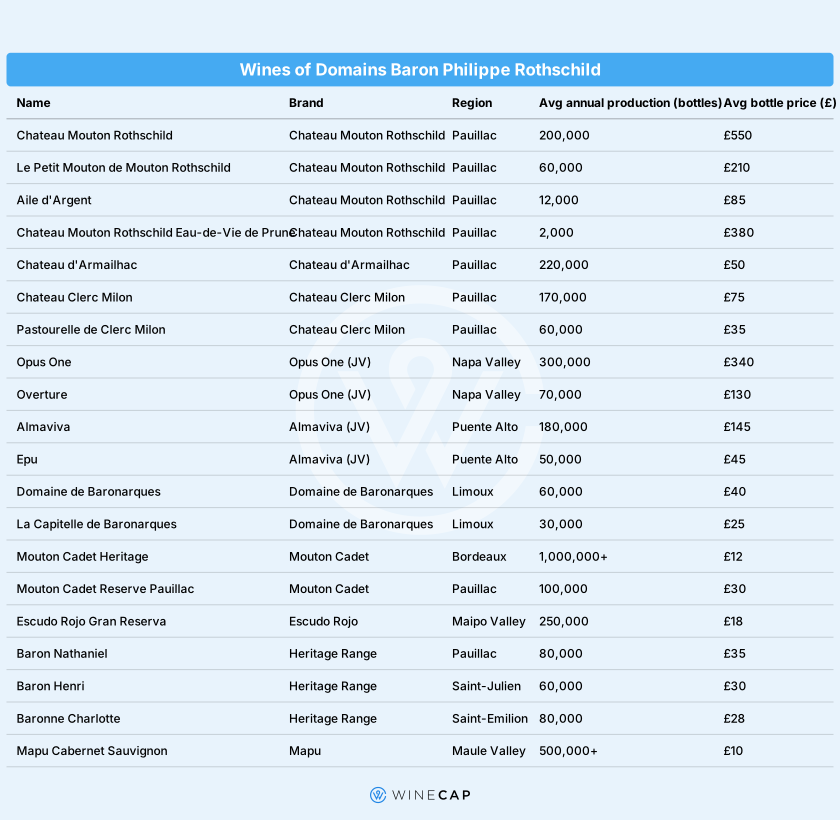
To understand Mouton Rothschild, one must understand its parent company, Baron Philippe de Rothschild SA (BPDR). Mouton Rothschild is not just a single estate but the heart of a global business that manages a vast portfolio of wines that spans from everyday consumer labels at under €10 a bottle to some of the most expensive wines on the market. This prolific nature gives the brand a reach that other First Growths, such as the more focused Chateau Latour, do not possess.
The branding strategy of BPDR is a masterclass in luxury management. While Mouton Cadet is a high-volume brand that brings the name into households worldwide, it does not dilute the prestige of the Grand Vin. Instead, it creates a “halo effect” where the name Rothschild becomes synonymous with quality across all price points. For the investor, the strength of the parent company provides a layer of institutional security. The family’s vast resources ensure that the estate can maintain its technical excellence even during challenging vintages.
4. A global footprint beyond Pauillac
The influence of the Rothschild family extends far beyond the borders of Bordeaux. Through strategic partnerships, BPDR has created some of the most successful international fine wine brands in history. The most prominent example is Opus One, a joint venture between Baron Philippe and Robert Mondavi in Oakville, California. Since its inception, Opus One has become the leader of the Californian secondary market.
Similarly, the family’s partnership with Concha y Toro in Chile produced Almaviva, a benchmark for South American investment-grade wine. These global ventures enhance the Mouton brand by associating it with excellence in different terroirs. For an investor, the success of these brands reinforces the reputation of the parent company as a reliable steward of high-value assets. It also creates a diversified network of demand, as collectors in the Americas and Asia often enter the world of fine wine through these local partnerships before moving toward the Bordeaux Grand Vin.
5. Investment resilience and the China boom
During the legendary “China boom” of the late 2000s, Bordeaux prices soared to unprecedented heights. While Chateau Lafite Rothschild was the primary beneficiary of this demand, it also suffered the most significant correction when the market fell after 2011. Mouton Rothschild, however, showed a different kind of resilience. While its prices did fall, they did not see the same level of correction as Lafite Rothschild. This was partly due to the broad global appeal of the Mouton brand, which is not solely reliant on a single market.
Mouton has shown similar resilience during the market fluctuations of 2022 to 2025, outperforming all its First Growth peers. For the UK investor, this stability is often combined with tax efficiency, as wine is generally classified by HMRC as a wasting asset, making capital gains potentially exempt from tax.
6. The iconic 2000 vintage: The Augsburg Ram
If there is one bottle that encapsulates the investment power of Mouton Rothschild, it is the 2000 vintage. To celebrate the new millennium, the estate broke with its tradition of commissioning an artist label. Instead, they produced a bottle featuring an intricate gold engraving of the “Augsburg Ram,” a 16th-century silver-gilt vessel from the family’s private museum. This bottle has become one of the most sought-after objects in the entire world of wine.
The performance of the 2000 vintage is a case study in market psychology. During the 2011 market downturn, when the prices of other First Growths fell sharply, the “gold ram” bottle held its value. It is often the first wine to see price increases when market sentiment improves, its recovery in 2013 and again in 2025 testament to its resilience. For collectors, the physical beauty of the bottle makes it a “must-have” asset that transcends the liquid inside. In 2015 (the Year of the Sheep in the Chinese zodiac), demand for this specific bottle spiked again, proving that cultural factors can drive investment performance in ways that traditional data cannot predict.
7. Vintage performance and critical scores
Like most Bordeaux wines, the quality of Mouton Rothschild has seen a dramatic and consistent rise since the 1990s – the result of investments in quality control, sanitation, phytosanitation and technology. While the estate had some inconsistent periods in the late 20th century, many recent vintages have achieved top scores from major critics. The 2016 in particular earned 100 point scores from almost a dozen critics including Neal Martin at Vinous and Lisa Perotti-Brown at Robert Parker’s Wine Advocate.
For the investor, the “value plays” are often found in the highly-scored recent releases that have not yet reached their full market potential. For example, the 2018 and 2020 vintages both carry 100-point scores but are currently trading at prices that are significantly lower than older vintages.
Similar to Lafite Rothschild, there is a strong case for investing in lower-scored vintages when prices are compelling. For instance, the 2013 Mouton Rothschild with a 92-point score from Neal Martin significantly outperformed the much higher quality 2009 and 2010 vintages from 2015 to the top of the market in 2022-2023 seeing 130% growth over that period.
8. Mouton Rothschild’s flamboyant tasting profile
In any comparative tasting of the First Growths, Mouton Rothschild is usually the easiest to identify. While Lafite is known for its understated elegance and Latour for its massive tannic power, Mouton is celebrated for its “flamboyant” personality. It is a wine of intense concentration, typically showing notes of roasted coffee, exotic spice, and a core of rich, dark cassis fruit.
This flamboyant style is a key part of its investment appeal. It is a wine that is relatively accessible in its youth compared to the more austere Latour, which can take decades to soften. This accessibility means that a higher percentage of the production is consumed earlier, naturally reducing the surviving stock of investment-grade bottles. As the supply of a vintage diminishes, the price of the remaining bottles tends to rise, creating a natural mechanism for capital appreciation.
9. Terroir and the Mouton plateau
The technical excellence of Mouton is rooted in its unique terroir. The estate is situated on the “Mouton plateau,” a section of land in the Pauillac AOC that consists of deep gravel over a limestone subsoil. Unusually for the region, Mouton boasts some of the highest hillocks in Pauillac, rising approximately 40 metres above sea level. This elevation is critical as it provides the vineyards with perfect natural drainage, ensuring that the vines are never “sitting in water” during wet periods.
The vineyard spans approximately 90 hectares, making it one of the larger properties in Pauillac. It is planted primarily with Cabernet Sauvignon (81%), with smaller amounts of Merlot and Cabernet Franc. The average age of the vines is over 50 years, with some plots reaching over 130 years of age. These old vines produce very small quantities of highly concentrated fruit, which is the secret to the wine’s immense structural power. For the investor, this consistency of terroir provides a physical guarantee of quality that spans across decades.
10. The legendary artist labels
The most famous aspect of Chateau Mouton Rothschild is its tradition of artist-designed labels. This began with the 1924 vintage and the 1927 design for Le Petit Mouton. Since 1945 this has been a permanent feature with the exception of 2000 and 2003. Every year, the chateau commissions a different world-renowned artist to create an original artwork for the label. The list of contributors is a who’s who of 20th and 21st-century art, including Pablo Picasso, Salvador Dali, Francis Bacon, Andy Warhol, and even the Prince of Wales (now King Charles III). Originals are kept on permanent display in the chateau and are open for the public to view.
The method of compensation for these artists is a fascinating part of the estate’s lore. The artists are not paid in cash but rather in wine: they receive five cases of the vintage for which they designed the label, along with five cases from other years in the estate’s cellar. This tradition creates an annual “marketing event” that keeps the brand at the top of global headlines. For investors, the labels make the wines highly collectible as a complete series. This “collect-them-all” mentality drives demand for older, rarer vintages as people look to fill gaps in their vertical collections.
FAQ: Mouton Rothschild
Why was Mouton the only estate promoted in 1973?
The promotion remains the only revision of the 1855 classification for red wines, making it a unique historical anomaly.
Which is the best value vintage of Mouton Rothschild today?
For those looking for high scores at a lower entry price, the 2018 and 2020 vintages are currently excellent value. Both have achieved 100-point scores but trade at a discount compared to older legendary years like 2010 or 2016.
Is there a white wine produced by Mouton Rothschild?
Yes, the estate produces a small amount of white wine called Aile d’Argent. It is a blend of Sauvignon Blanc and Semillon. While it is a high-quality wine, it does not have the same secondary market liquidity or investment track record as the red Grand Vin.
WineCap’s independent market analysis helps investors build diversified fine wine portfolios with full ownership and transparent pricing. Speak to one of our wine investment experts and start building your portfolio. Schedule your free consultation today.